
Motor Duty Cycles: S1, S2 and S3 Explained for Gear Motors
A buyer sends an RFQ that says “24 V planetary gear motor, 25 kgf·cm, 100 rpm, intermittent duty.” The supplier quotes a unit rated 25 kgf·cm continuous. Six months later the same unit comes back with browned grease and a melted brush holder. Nobody lied. The duty type was never defined, and in a gear motor that single omission can change the allowable torque by a factor of two.
This article walks through the IEC 60034-1 duty types that actually matter for small gear motors (S1, S2, S3, S6, and the S4 variant that carries starting), then does the arithmetic that turns a duty into a torque number, and finally covers the part most datasheets skip: in a gear motor the winding is rarely the component that limits you. The grease and the plastic gears usually give up first.
What a duty type actually specifies
A duty type in IEC 60034-1 is a statement about three things: how long the machine carries load, how long it rests, and whether the rest is long enough to return the machine to ambient. Every S-designation is a different answer to those three questions, and the standard requires the answer to be written down, not implied.
The practical consequence is that “intermittent duty” on its own is not a rating. S3 25% with a 10-minute cycle and S3 25% with a 30-minute cycle are different machines in thermal terms, and the standard expects both the cyclic duration factor and the cycle duration to appear on the nameplate or in the quotation.
IEC 60034-1:2026 is the current edition of the rating standard and defines S1 through S10. IEC 60085:2007 defines the thermal class of the winding insulation that sits behind those duty ratings. Both matter here because duty types are ultimately thermal arguments dressed up as schedules.
<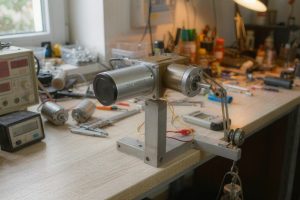 >
Figure 1: Bench setup for a duty-cycle run — 28 mm planetary gear motor in a fixture, belt-loaded, with a thermocouple on the gearbox housing.
The five duty types that cover most gear motor work
Ten duty types exist. For small DC and BLDC gear motors, five of them cover almost every real application, and the differences between them are not academic — each one changes what the supplier is allowed to promise.
| IEC duty type | Definition in plain terms | Typical gear motor application | What the RFQ must state |
|---|---|---|---|
| S1 | Constant load, run until thermal equilibrium, no rest period | Conveyor drive, continuous pump, always-on actuator | Ambient temperature, mounting orientation, enclosure |
| S2 | Constant load for a defined short period, starting from cold, then rest long enough to cool to within 2 K of ambient | Gate opener, dock leveller, valve stroke, reject arm | Load duration in minutes (10 / 30 / 60 / 90 are the usual bands) |
| S3 | Repeated identical cycles of load and rest, rest too short to reach ambient | Mixer, vending dispenser, medical recliner, packaging indexer | Cyclic duration factor (ED %) and cycle duration |
| S4 | S3 plus a starting phase inside each cycle, with significant starting current | High-inertia indexing table, auger start under load | ED %, cycle duration, starts per hour, load inertia |
| S6 | Repeated load and no-load periods, no rest at all | Fast-cycle sorting diverter, damper actuator | Load and no-load durations per cycle |
The two rows buyers most often collapse into one are S2 and S3, and that collapse is where margins disappear. S2 buys you a big number because the machine is allowed to cool completely between runs. S3 does not: the motor never fully cools, so the average loss is what sets the temperature, and the peak torque advantage is much smaller than an S2 quote would suggest.
S1 is the only rating you can compare across suppliers
An S1 rating at a stated ambient is a thermal equilibrium statement: at that torque, the machine stabilises at a temperature rise it can survive indefinitely. Because it is self-contained, it is the only rating you can put side by side across two suppliers without asking follow-up questions.
When a datasheet gives you a torque with no duty type, assume it is not an S1 rating. In our own product tables the headline torque is the maximum-efficiency operating point — the point where output power peaks on the speed-torque line — not a continuous thermal limit. Those are different numbers, often by 30–50%. How to read a motor datasheet covers that distinction in detail; the short version is that neither number is wrong, but only one of them tells you what the motor will do all day.
S2 buys torque with time, and the time is the whole contract
An S2 rating is only valid for the duration printed next to it. A 28 mm gear motor quoted at twice its S1 torque for S2 10 min will not survive S2 30 min at that torque, because 30 minutes is longer than its thermal time constant and the machine reaches equilibrium well before the period ends.
This is why the standard’s preferred S2 durations are coarse (10, 30, 60 and 90 minutes): they bracket the thermal behaviour of real machines rather than describing it precisely. If your actual load period is 18 minutes, an S2 30 min rating is conservative and an S2 10 min rating is fiction.
S3 needs two numbers, and “25% ED” alone is not a specification
S3 is defined by a cyclic duration factor: the loaded time divided by the cycle time. It says nothing about how long the cycle is, and that gap is the single most common source of misquoted torque in small gear motors.
Consider two drives, both honestly labelled S3 25%:
- Drive A: 15 s on, 45 s off. Cycle 60 s.
- Drive B: 7.5 min on, 22.5 min off. Cycle 30 min.
Drive A’s motor never cools between cycles. Its temperature is governed by the average loss over the minute, so the RMS torque method applies almost exactly and the 25% ED bonus is real but limited by the no-load current that flows during the off time only if the drive keeps the motor energised.
Drive B’s motor cools to near ambient during each rest. It can carry a much higher torque during the loaded 7.5 minutes — closer to a true S2 rating — but the winding is cycling through a wide temperature swing twice an hour, and solder joints, brush springs and grease all see that as fatigue.
Same ED number. Different machine. Different price.
<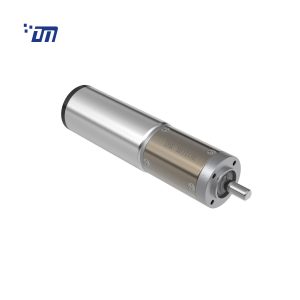 >
Figure 2: DM-28PM2965 28 mm planetary gear motor, front view — the platform used for the worked example below.
Why the thermal time constant decides whether your S3 rating is real
Every motor has a thermal time constant τ: the time it takes to reach roughly 63% of its final temperature rise after a step in load. For a 28 mm gear motor τ is typically in the 8–15 minute range; for a 42 mm brushless planetary unit it is longer, often 20–35 minutes, because there is more mass and more surface area but the loss density is lower.
The ratio of cycle duration to τ tells you which thermal regime you are in:
| Cycle duration ÷ τ | Thermal regime | How to size the motor |
|---|---|---|
| Under 0.3 | Near-steady temperature | Use RMS torque over the cycle; peak torque is limited by the gearbox, not the winding |
| 0.3 to 1.0 | Transitional | Add 10–15% margin over the RMS result; verify with a thermocouple run |
| 1.0 to 3.0 | Partial cool-down | Rated point is between RMS and S2; demand a measured temperature-rise curve |
| Over 3.0 | Full cool-down per cycle | Treat as S2 with the on-time as the rating period |
This table is a sizing heuristic, not a standard. It exists because the RMS calculation silently assumes the near-steady regime, and buyers apply it to 30-minute cycles where it is too optimistic on peak temperature and too pessimistic on average.
The practical fix is cheap: ask the supplier for a temperature-rise curve at your duty, or run one yourself. Tape a K-type thermocouple to the gearbox housing, not the motor can. The housing is where the grease lives, and as the next section shows, that is the number that matters.
The derating arithmetic, on one line
For a duty cycle where the motor is energised and loaded for part of the cycle and unloaded or off for the rest, the thermally equivalent torque is:
T_rms = T_load × √(ED)
where ED is the fraction of the cycle spent under load. Copper loss scales with current squared, current scales roughly with torque in a permanent-magnet DC motor, so the average loss scales with the square of the RMS torque.
For the DM-28PM2965 24 V 51:1 configuration, the datasheet gives 150 rpm at 27.5 kgf·cm (2.7 N·m) and 42.5 W output at the maximum-efficiency point, with 270 kgf·cm (26.5 N·m) stall torque at 22.7 A. Take the maximum-efficiency torque as the reference and apply the square-root rule:
| ED | √ED | Equivalent continuous torque | Realistic value after correction |
|---|---|---|---|
| 100% | 1.00 | 2.70 N·m | 2.70 N·m (only if the S1 rating confirms it) |
| 60% | 1.29 | 3.48 N·m | 3.0 N·m |
| 40% | 1.58 | 4.27 N·m | 3.6 N·m |
| 25% | 2.00 | 5.40 N·m | 4.2 N·m |
| 15% | 2.58 | 6.97 N·m | 4.8 N·m |
| 10% | 3.16 | 8.53 N·m | 5.2 N·m |
The gap between column three and column four is deliberate. Three corrections pull the theoretical number down:
No-load current. During the loaded portion the motor draws load current plus no-load current. At low torque the no-load term dominates, which is why the square-root rule overstates the bonus for lightly loaded, high-ED applications.
Hot winding resistance. Copper resistance rises about 0.4% per kelvin. A winding that starts at 20 °C and stabilises at 120 °C has resistance roughly 40% higher than the cold value, so the same current produces 40% more loss. Derate by 1.15 to 1.25 depending on how hot the machine runs.
Gearbox breaking torque. Above four stages, torque capability plateaus: on the 22 mm platform the breaking torque stops at 5 N·m from the fourth stage onward, and on the 28 mm platform it stops at 40 N·m. A 10% ED calculation that promises 8.5 N·m on a gearbox with a 6 N·m breaking torque is arithmetic without a mechanism behind it. How stage count sets the torque ceiling works through that limit.
The gearbox is usually the limit, not the winding
Winding insulation classes are generous. Class B allows a 130 °C hotspot and class F allows 155 °C, which sounds like enormous headroom in a 40 °C ambient. It is not where the failure happens.
The binding constraints in a small gear motor are, in order:
- Grease life. Most greases used in 16–42 mm gearboxes hold their base oil and their consistency below a housing temperature of roughly 80–90 °C. Above that, oxidation and base-oil separation accelerate sharply, the grease hardens in the tooth roots, and the gearbox starts making noise before it starts failing. By the time the winding is at 110 °C the grease may already be past its useful life.
- Plastic gear strength. POM and PA66-GF30 gears lose stiffness well before they melt. Continuous service temperatures above 90–100 °C move the material toward its heat-deflection region, and a duty cycle with a hot peak each hour will creep the tooth profile.
- Brush and commutator temperature. In a brushed unit the brush film that keeps wear low depends on a moderate, stable interface temperature. Hot running with long rest periods produces a thin, patchy film and rapid brush wear on restart.
- Winding insulation. Last, not first. It fails after the grease has already degraded.
Here is the number that makes the point concrete. At 81% gearbox efficiency — the two-stage figure on the 28 mm platform — delivering 42.5 W at the output means about 52.5 W is going into the gearbox, so roughly 10 W is being dissipated as heat inside a gearbox whose diameter is 28 mm. Ten watts in that volume, continuously, is a housing temperature rise of several tens of kelvin. Add the motor’s own losses and the assembly is thermally busy at a torque that the datasheet presents as an ordinary operating point.
The loss accounting behind that figure — what counts as output, what counts as loss, and how the efficiency chain is measured — is standardised in IEC 60034-2-1, which is the reference to quote when a supplier’s efficiency number and your measurement disagree.
The consequence for specification writing is direct: when you ask for a duty rating, ask for it at the housing, not at the winding. A supplier who can only quote winding class is quoting a limit you will never reach.
<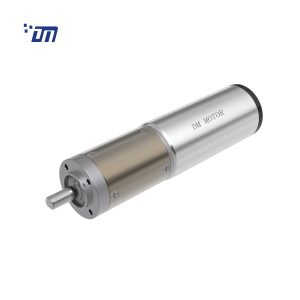 >
Figure 3: Rear view of the same unit — terminals and motor can. The gearbox housing, not the can, is where the grease temperature decides the duty rating.
What to put on the RFQ so the supplier quotes the same duty
A duty definition that survives quotation, sampling and mass production has six lines. Anything less and the supplier will fill the gap with an assumption that favours the quote.
- Duty type and period. “S3, 25% ED, 60 s cycle” not “intermittent”. For S2, the on-time in minutes.
- Torque profile, not just peak. Load torque during the loaded phase, plus any acceleration torque and its duration. Acceleration torque is often 1.5–2× the running torque and is frequently left out.
- Starts per hour. S4 and S3 both care, and starting current heats the winding far faster than running current.
- Ambient and mounting. 25 °C in a laboratory and 45 °C inside a sealed enclosure with no airflow are different machines. Mounting orientation changes convection on a gearbox flange.
- The measurement point. State that the temperature rise will be checked on the gearbox housing, and at what distance from the motor interface.
- Acceptance method. Temperature-rise test at the specified duty, with the pass criterion in kelvin, not “does not overheat”.
If the application is genuinely continuous, ask for the S1 torque at your ambient and accept a larger frame. Upsizing one frame is usually cheaper than the warranty cost of a browned gearbox, and it removes the argument about whether the rest period was long enough.
Three failures that trace back to a duty mismatch
These are the patterns that show up when a gear motor is chosen on a peak-torque number and installed on an S3 schedule.
The grease that turned to wax. A vending dispenser ran an S3 cycle of 4 s on, 26 s off. The integrator sized to the S2-equivalent torque from a competitor’s datasheet and saw no problem in the first month. By month four the gearbox was noisy and the current had risen 30% at the same load. The grease had separated; the thickened soap had migrated out of the tooth mesh. The fix was not a bigger motor, it was a lower-torque ratio and a grease rated for the housing temperature the application actually produced.
The brush that wore out in one month. A gate operator with a 90-second cycle and a long rest looked like an easy S2 case. The problem was that each start drew a current spike several times the running current, and the machine did 40 starts an hour. Brush wear is driven by starts per hour far more than by running hours. The redesign kept the same motor and added a soft-start ramp; brush life went from one month to over a year.
The motor that was fine until summer. A conveyor drive specified at 25 °C ambient was installed inside a control cabinet that reached 48 °C in July. The S1 rating was honest at 25 °C. At 48 °C the same torque pushed the housing past the grease limit, and the failures clustered in the warm months. Thermal margin is not a safety factor you add at the end; it is a term in the rating.
Choosing between S1 and S3 is a cost decision, not a technical one
Both are legitimate. The choice comes down to whether the extra cost of a larger S1-rated unit is higher or lower than the risk you take with a smaller S3-rated one.
For a consumer product shipping in volume, with a duty that never varies and a housing you control, an S3 rating backed by a temperature-rise test is the right economic answer. For industrial equipment where the end user may change the cycle or run it in a hot enclosure, an S1 rating with margin usually costs less over the warranty period even though the unit price is higher.
The wrong answer is an S3 rating with no cycle duration and no temperature-rise data. That is not a cheaper design, it is an unpriced one. How to choose the right motor puts the duty definition ahead of every other selection criterion for exactly this reason.
Matching the duty to the gearbox, not just the motor
Duty type is usually discussed as a motor question, but in a gear motor the gearbox has its own duty limits that are not derivable from the motor’s.
Peak torque loads the teeth; average torque loads the grease. A duty with a high peak and a long rest will pass a motor thermal check and still fatigue the first-stage planet pins. For anything with repeated shock loading, specify the peak torque against the gearbox breaking torque with a margin of at least 1.5, and separately check the tooth bending stress at that peak if the application is safety-relevant.
For the ratio arithmetic behind all of this — how output torque, output speed and the loss stack combine — the worked example in calculating planetary gear motor torque and speed ratio uses the same 28 mm platform numbers, so the two articles can be read as a pair.
FAQ
Is S1 always the safest choice?
Safest, yes; cheapest, no. S1 forces the design to survive thermal equilibrium at the rated torque, which usually means a larger frame or a lower ratio. If your duty is genuinely short and repeatable, an S2 or S3 rating with measured temperature-rise data is a legitimate and cheaper answer. What is not legitimate is an S3 rating with no cycle duration attached.
Can I just add a fan and keep the small motor?
Sometimes, and it is often the cheapest fix. Forced air over the gearbox housing can cut housing temperature by 15–25 K depending on airflow and orientation, which may be enough to bring an S3-rated unit into S1 territory. The catch is that the fan becomes a life-limited component and a dust path into the gearbox; on sealed or washdown equipment, upsizing is cleaner.
Why does my motor run hotter after a gearbox change with the same ratio?
Efficiency. Two gearboxes with the same ratio can differ by 8–12 percentage points in efficiency depending on stage count, gear material and grease fill. At 42 W output, that difference is 4–6 W of extra heat inside the same housing. Ratios match, thermal behaviour does not.
Does the duty type change the noise specification?
It changes what the noise number means. Noise measured cold at no load is not the noise the customer hears after 20 minutes of a 25% ED cycle, when the grease has thinned and the housing has expanded. For applications where noise is a spec, measure at thermal equilibrium, not on a cold unit.
How do I verify a supplier’s S3 claim without a test lab?
Run the duty for at least three full cycles with a thermocouple on the gearbox housing and log the temperature at the end of each loaded period. If the peak housing temperature keeps climbing cycle after cycle, the rating is optimistic. If it plateaus below roughly 80 °C, the claim holds. That test needs a thermocouple, a timer and half a day.
Where this leaves the specification
A duty type is not a label you copy from a catalogue. It is the input that decides the torque number, and in a gear motor it is bounded by the grease and the gears more often than by the winding. Write the duty as a schedule — type, ED, cycle duration, starts per hour, ambient, measurement point — and the torque follows from arithmetic instead of from optimism.
If you are sizing a planetary or BLDC gear motor for a duty that does not fit neatly into S1, send the cycle profile with the RFQ. The DC planetary gear motor range covers 16 mm to 63 mm frames, and the DM-28PM2965 used in the examples above is documented with its full stage table on the product page. For duty definitions that sit between two categories, the overheating causes and prevention guide covers the thermal failure modes in more depth, and if the terms here are new, start with what a DC gear motor is before specifying one.