
Key Factors Influencing Custom Micro DC Motor Costs in Mass Production
For OEM products, the cost of a custom micro DC motor can have a significant impact on the final product’s profitability. However, the lowest motor unit price is not always the best solution.
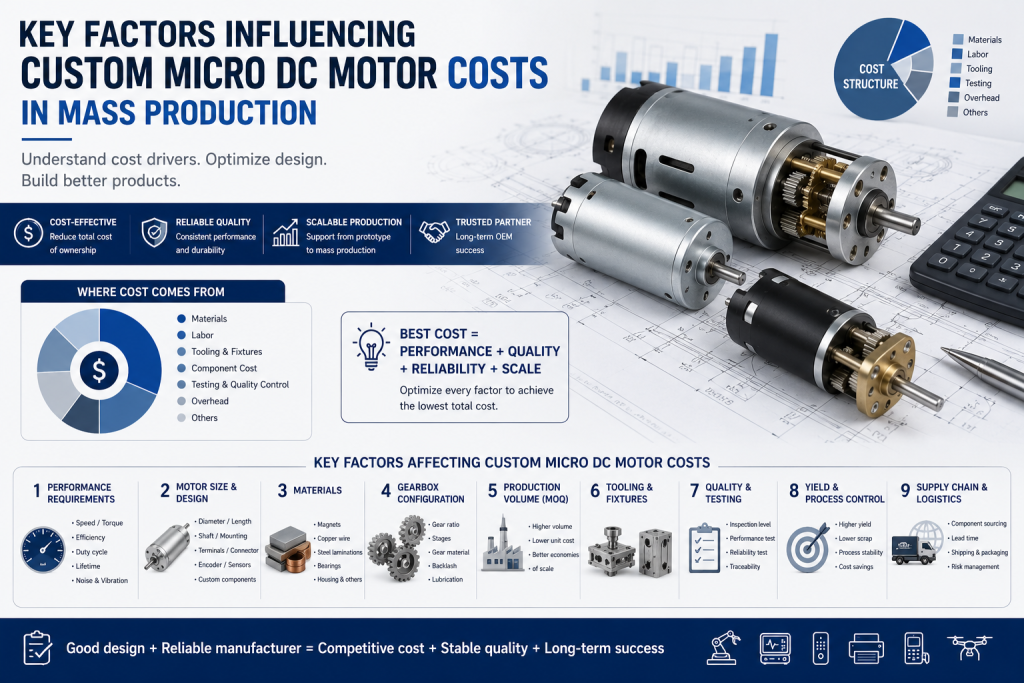
In mass production, motor cost is influenced by the electrical design, mechanical structure, materials, gearbox configuration, production volume, tooling, testing requirements, and manufacturing yield.
Understanding these factors helps engineers design a cost-effective motor while helping purchasing teams negotiate based on actual technical requirements.
1. Motor Specifications and Performance Requirements
The first cost driver is the required performance.
Typical parameters include:
- Rated voltage
- No-load speed
- Rated speed
- Continuous torque
- Stall torque
- Efficiency
- Operating current
- Duty cycle
- Lifetime
- Noise and vibration
Higher torque, higher efficiency, longer lifetime, or tighter speed tolerance may require better materials, tighter manufacturing tolerances, or additional testing.
For example, a micro DC motor designed for intermittent operation may use a different winding and thermal design from a motor required to operate continuously for thousands of hours.
Therefore, engineers should define the actual operating point rather than simply requesting the maximum possible torque or speed.
2. Motor Size and Custom Mechanical Design
The physical dimensions of a custom micro DC motor directly affect manufacturing cost.
Custom requirements may include:
- Special motor diameter
- Reduced motor length
- Customized shaft
- Special mounting holes
- Customized terminals
- Connector configuration
- Gearbox dimensions
- Encoder installation
Non-standard components generally increase tooling, setup, and production costs.
If possible, using an existing motor platform and customizing only the necessary components can significantly reduce development cost and shorten lead time.
For OEM projects, the most economical design is often platform-based customization rather than designing every component from zero.
3. Magnet, Copper and Core Materials
Material selection has a direct effect on motor cost.
Important components include:
- Permanent magnets
- Copper wire
- Laminated steel
- Commutator
- Carbon brushes
- Bearings
- Gear materials
- Housing materials
For higher-performance motors, stronger magnets, higher-grade magnetic materials, larger copper wire, or improved bearings may be required.
However, selecting premium materials without a clear performance requirement can unnecessarily increase cost.
The goal should be:
Use the lowest-cost material that reliably meets the required performance and lifetime.
4. Gearbox Design Can Significantly Change Cost
If the application requires high torque and low speed, a custom micro DC gear motor may be required.
Gearbox cost depends on:
- Gear ratio
- Number of stages
- Gear material
- Gear accuracy
- Gear diameter
- Lubrication
- Bearing configuration
- Backlash requirement
- Output torque
- Output shaft load
A higher reduction ratio often requires additional gear stages.
For example, a simple 10:1 gearbox may require fewer stages than a 100:1 gearbox, resulting in differences in component count, assembly time, efficiency, and overall cost.
For high-volume OEM products, engineers should select the lowest practical gear ratio that meets the required output speed and torque.
5. Production Volume and MOQ
Production volume is one of the most important factors affecting the unit cost of a micro DC motor.
Fixed costs such as:
- Tooling
- Fixtures
- Engineering development
- Testing setup
- Production setup
can be distributed across more units when production volume increases.
For example, the economics of producing 1,000 prototype motors are very different from producing 100,000 motors annually.
A useful way to think about OEM motor pricing is:
[ Unit Cost Variable Manufacturing Cost + ]
Therefore, purchasing teams should evaluate both unit price and total project cost.
6. Tooling and Custom Components
A new custom motor may require tooling for:
- Plastic injection parts
- Metal stamping
- Housing components
- Gear production
- Shaft machining
- Assembly fixtures
- Testing fixtures
Tooling costs can be significant during the initial development stage but become relatively small on a per-unit basis in mass production.
Before starting an OEM project, clarify whether tooling is:
- Included in the quotation
- Charged separately
- Owned by the customer
- Owned by the manufacturer
- Reusable for future production
This prevents unexpected costs during the transition from prototype to mass production.
7. Precision and Tolerance Requirements
Tighter tolerances increase manufacturing difficulty.
For a micro DC gear motor, critical tolerances may include:
- Shaft diameter
- Shaft runout
- Gear center distance
- Gear backlash
- Bearing fit
- Housing dimensions
- Commutator dimensions
A requirement such as “very low backlash” or “highly accurate output speed” should be supported by a measurable specification.
For example:
Better: Backlash ≤ X° under defined test conditions.
Less useful: Very low backlash.
Engineering teams should avoid specifying unnecessarily tight tolerances because they can increase machining, inspection, rejection rate, and overall custom DC motor manufacturing cost.
8. Quality Control and Testing Requirements
Mass production requires more than manufacturing the motor; it also requires verifying every production batch or every unit.
Testing may include:
- No-load speed
- No-load current
- Rated load torque
- Stall current
- Direction
- Noise
- Vibration
- Gearbox backlash
- Encoder signal
- End-of-line electrical testing
A 100% inspection requirement generally costs more than sampling inspection.
However, for critical OEM applications, additional testing may reduce field failures and warranty costs.
The correct approach is to identify critical-to-quality parameters and apply the appropriate inspection strategy.
9. Efficiency and Energy Consumption
For battery-powered products, motor efficiency can influence the total system cost.
A more efficient motor may cost slightly more but reduce:
- Battery capacity requirements
- Operating temperature
- Power consumption
- Cooling requirements
- Charging frequency
Therefore, engineers should evaluate:
[ Total Cost = Motor Cost + Energy Cost + Failure Cost + Maintenance Cost ]
For products manufactured in large quantities and used frequently, optimizing efficiency can provide a better economic return than minimizing the initial motor price.
10. Manufacturing Yield Matters
One of the most overlooked factors in micro DC motor cost for mass production is manufacturing yield.
Suppose two suppliers offer similar material and labor costs, but one has a significantly higher production yield.
The supplier with better process control may provide a lower effective manufacturing cost because fewer motors require:
- Rework
- Adjustment
- Rejection
- Replacement
- Additional inspection
Important process-control parameters may include winding resistance, brush contact, gear backlash, shaft runout, motor current, speed, and output torque.
For OEM purchasing, consistent quality at high volume can be more valuable than a small difference in initial quotation price.
11. How Engineers Can Reduce Custom Micro DC Motor Cost
A practical cost-optimization strategy is:
- Define the actual load
Avoid specifying excessive torque or speed margins without engineering justification.
- Use standard components where possible
Standard bearings, shafts, connectors, and gear components can reduce tooling and procurement costs.
- Optimize the gear ratio
Select the ratio based on the actual speed-torque requirement.
- Avoid unnecessary precision
Specify measurable tolerances according to application requirements.
- Design for mass production
Reduce the number of components and simplify assembly.
- Optimize testing
Focus 100% inspection on critical parameters and use sampling inspection where appropriate.
- Forecast annual demand
A realistic volume forecast allows the manufacturer to optimize materials, tooling, and production capacity.
12. What Should Purchasing Ask a Micro DC Motor Supplier?
When comparing an OEM micro DC motor supplier, purchasing teams should request more than a unit price.
Compare:
| Item | What to Check |
| Unit Price | Based on actual annual volume |
| MOQ | Prototype vs. mass production |
| Tooling | Cost and ownership |
| Lead Time | Sample and production |
| Material | Magnet, copper, gears, bearings |
| Testing | 100% or sampling |
| Quality | Process and traceability |
| Lifetime | Tested operating conditions |
| Customization | Motor, gearbox, shaft, connector |
| Capacity | Monthly production capability |
| Packaging | Custom packaging requirements |
This provides a more accurate comparison between suppliers.
Conclusion
The cost of a custom micro DC motor is determined by much more than raw materials.
The major factors include:
Performance → Materials → Motor Design → Gearbox → Precision → Tooling → Production Volume → Testing → Yield → Supply Chain
For engineers, the best cost optimization strategy is to design the motor around the actual application requirements.
For purchasing teams, the right approach is to compare total cost of ownership and production reliability, rather than selecting the supplier with the lowest initial quotation.
A reliable custom micro DC motor manufacturer should be able to balance performance, manufacturability, quality, and cost from prototype development through mass production.
The goal is not simply to build the cheapest motor—it is to build the most cost-effective motor that consistently meets the application’s performance and lifetime requirements.