
Precision Micro DC Gear Motors for Smart HVAC Zone Control Valves
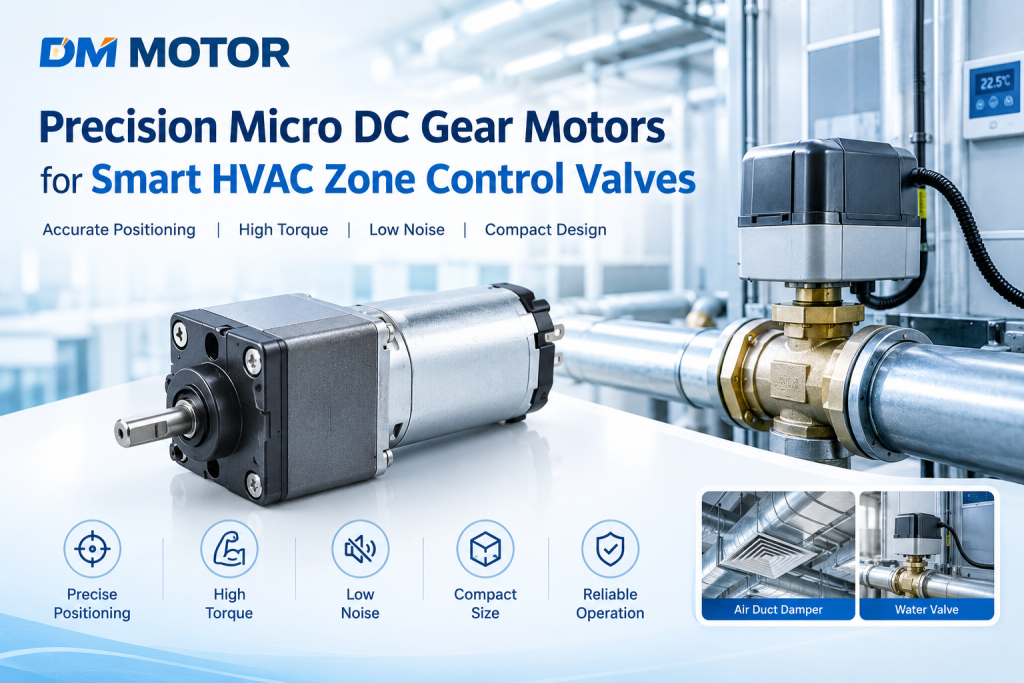
Modern HVAC systems increasingly use independent zone control to regulate room temperature more efficiently. Smart thermostats, building automation systems, and connected HVAC controllers can adjust individual zones by controlling dampers and motorized water valves.
At the mechanical level, the actuator motor is responsible for converting electrical commands into controlled valve movement.
For compact smart HVAC equipment, a micro DC gear motor can provide an effective combination of high torque, low output speed, compact dimensions, and controllable positioning.
Selecting the right HVAC zone control valve motor requires more than simply choosing a small motor. Engineers need to consider valve torque, gear ratio, positioning accuracy, noise, duty cycle, power consumption, and installation space.
1. Why Micro DC Gear Motors Are Used in Smart HVAC Valves
A typical DC motor provides relatively high rotational speed but limited direct output torque. Adding a gearbox reduces speed while increasing available output torque.
This makes a precision DC gear motor suitable for compact valve actuators where the valve may need to rotate slowly and accurately.
Typical functions include:
Opening and closing water valves
Modulating heating and cooling flow
Controlling fan-coil unit valves
Adjusting hydronic zone valves
Managing independent HVAC zones
Supporting automated temperature regulation
Compared with a standard DC motor, the geared configuration allows engineers to match motor output more closely to the mechanical requirements of the valve.
2. Torque Is the First Specification to Check
For an HVAC zone control valve motor, torque is normally one of the most important selection parameters.
The actuator must overcome not only the nominal valve resistance but also friction, sealing force, gearbox losses, and variations caused by system pressure.
A basic engineering relationship is:
Tmotor,out≥Tvalve×ST_{motor,out} \geq T_{valve} \times S
Where:
Tmotor,outT_{motor,out} = Required motor gearbox output torque
TvalveT_{valve} = Actual valve operating torque
SS = Engineering safety factor
For example, if the valve requires 0.5 N·m and the design uses a 1.5 safety factor:
0.5×1.5=0.75 N⋅m0.5 \times 1.5 = 0.75\ N·m
The gearbox therefore needs to deliver approximately 0.75 N·m or more under the defined operating conditions.
However, engineers should not select a motor solely from the stall torque value. Stall conditions produce high current and significant thermal stress.
For real product development, rated load, startup torque, duty cycle, and thermal behavior should all be verified.
3. Gear Ratio Determines More Than Just Torque
The gear ratio determines the relationship between motor speed and actuator output speed.
A simplified relationship is:
nout=nmotorin_{out} = \frac{n_{motor}}{i}
Where:
noutn_{out} = Gearbox output speed
nmotorn_{motor} = Motor speed
ii = Gear ratio
A higher reduction ratio generally provides lower output speed and higher output torque.
For HVAC zone valves, the correct ratio depends on the required valve travel time.
For example:
Fast open/close valve → lower reduction ratio may be sufficient
Slow proportional control → higher reduction ratio may be more suitable
High-load valve → higher reduction ratio may be required
Precision positioning → gearbox backlash becomes increasingly important
This means gear ratio should be selected together with torque, response time, and control accuracy rather than as an isolated specification.
4. Positioning Accuracy Matters in Smart Zone Control
Traditional HVAC systems may only require simple open/close movement. Smart HVAC systems often need more precise valve positioning.
For example, a controller may command a valve to move to 30%, 50%, or 70% opening depending on temperature and flow requirements.
In this situation, the actuator may use:
Hall sensors
Magnetic encoders
Optical encoders
Limit switches
Potentiometers
A precision DC motor for smart HVAC actuators can be combined with feedback devices to improve repeatability and closed-loop control.
Engineers should evaluate:
Gearbox backlash
Output shaft accuracy
Sensor resolution
Position repeatability
Mechanical end-stop behavior
Low gearbox backlash becomes particularly important when small valve movements must correspond to controlled changes in fluid flow.
5. Low Noise Is Important for Indoor HVAC Equipment
HVAC zone control valves are often installed close to occupied areas.
A motor that is technically powerful but mechanically noisy may create an undesirable user experience.
Noise can come from several sources:
Motor electromagnetic noise
Brush and commutator noise
Gear tooth meshing
Bearing noise
Structural resonance
A low noise DC gear motor for HVAC systems should therefore be evaluated as a complete mechanical system rather than by motor noise alone.
Possible methods for reducing noise include:
Optimized gear geometry
Appropriate gearbox reduction
Lower motor operating speed
Improved lubrication
Better bearing selection
Vibration isolation
Proper actuator housing design
Testing should ideally be performed under actual load because gearbox and structural noise can change significantly between no-load and loaded operation.
6. Compact Size Enables Smaller Smart HVAC Actuators
Smart HVAC controllers are becoming increasingly compact, creating tighter actuator installation requirements.
A micro DC gear motor for HVAC zone valves can help reduce actuator size by combining the motor and gearbox into a small integrated drive unit.
Important dimensional parameters include:
Motor diameter
Overall motor length
Gearbox dimensions
Output shaft diameter
Shaft length
Mounting hole pattern
Connector position
For OEM designs, the gearbox housing and output shaft can sometimes be customized to match the valve body and actuator enclosure.
This is particularly useful when an actuator must fit into a restricted installation area.
7. Brushed vs. Brushless Micro DC Gear Motors
Both brushed and brushless motor technologies can be used for HVAC actuator applications.
Brushed DC Gear Motors
Advantages include:
Simple electrical control
Lower system complexity
Cost-effective design
Easy forward/reverse operation
They are often suitable for intermittent actuator movement and cost-sensitive products.
Brushless DC Gear Motors
BLDC motors eliminate mechanical brushes and use electronic commutation.
Potential advantages include:
Reduced brush wear
Long operating life potential
Suitable for frequent operation
Good efficiency under appropriate conditions
The trade-off is increased electronic control complexity and the need for a suitable driver.
For a smart HVAC actuator operating thousands of positioning cycles, the motor technology should be selected according to required lifetime, duty cycle, electronics architecture, and total system cost.
8. Duty Cycle and Lifetime Should Be Evaluated Together
HVAC valves may appear to operate slowly, but the actuator can perform a large number of movement cycles over its service life.
Consider:
Number of daily movements
Motor starting frequency
Average operating load
Valve travel angle
Holding time
Ambient temperature
For brushed motors, repeated start-stop operation contributes to brush and commutator wear.
For geared systems, gearbox wear and lubricant performance also become important.
Instead of asking only for “motor life,” OEM engineers should request test data under defined conditions such as:
Voltage + Load + Speed + Cycle Pattern + Ambient Temperature
This produces much more meaningful reliability information.
9. Power Consumption and Thermal Performance
A smart HVAC actuator may spend most of its time in a standby state and only operate periodically.
This makes efficient motor selection important for systems powered by batteries, low-voltage supplies, or energy-sensitive control modules.
Motor current should be evaluated at:
No load
Normal operating load
Startup
Peak mechanical load
Near-stall conditions
Thermal performance should also be considered.
A compact actuator enclosure can restrict heat dissipation, causing the motor temperature to rise faster than expected.
Therefore, the custom micro DC gear motor for HVAC valves should be evaluated inside the actual actuator housing whenever possible.
10. When a Custom Motor Is Better Than a Standard Motor
A standard motor can work well when the required torque, speed, dimensions, and control method match an existing product.
Custom development becomes more valuable when the HVAC actuator has specific mechanical constraints.
Customization may include:
Special gear ratio
Customized output shaft
Non-standard mounting holes
Integrated Hall sensor
Encoder option
Modified motor voltage
Compact gearbox design
Low-noise gear configuration
Customized connector and cable
For OEM HVAC products, early motor selection can also reduce later redesigns of the actuator housing.
11. Practical Selection Checklist
Before approving a micro DC gear motor for HVAC zone valves, engineering teams should verify:
☑ Valve operating torque
☑ Required safety factor
☑ Output speed and travel time
☑ Gear ratio
☑ Gearbox backlash
☑ Operating voltage
☑ Startup and peak current
☑ Duty cycle
☑ Required life cycles
☑ Ambient operating temperature
☑ Noise and vibration
☑ Motor and gearbox dimensions
☑ Position feedback requirements
☑ Output shaft configuration
☑ Mechanical mounting interface
The motor should ultimately be evaluated as part of the complete actuator assembly.
FAQ
What type of motor is suitable for an HVAC zone control valve?
A micro DC gear motor is suitable for many compact HVAC valve actuators because it can provide low speed and increased output torque in a small package. The appropriate motor depends on valve torque, speed, duty cycle, and control requirements.
How much torque does an HVAC zone valve motor need?
There is no universal torque value. The required torque depends on valve construction, sealing force, friction, fluid pressure, and transmission design. Actual valve torque should be measured and then combined with an appropriate engineering margin.
Is a brushed DC motor suitable for smart HVAC valves?
Yes. A brushed motor can be suitable for applications requiring simple control and intermittent operation. For high cycle counts or long service-life requirements, a BLDC solution may also be evaluated.
Do HVAC zone valves need encoders?
Not always. Simple open/close valves can use limit switches or other end-position methods. Modulating or smart valves may benefit from Hall sensors or encoders for more precise position control.
Can a micro DC gear motor be customized for a specific HVAC valve?
Yes. For OEM applications, motor diameter, gearbox ratio, shaft dimensions, mounting configuration, voltage, feedback components, and other parameters can be customized according to the actuator design.
Smart HVAC zone control requires compact actuators that can deliver reliable torque, controlled movement, and repeatable positioning.
A properly selected precision micro DC gear motor can provide the combination of torque multiplication, controlled output speed, compact size, and feedback compatibility required for modern HVAC valve systems.
For engineers developing smart thermostatic valves, hydronic zone valves, fan-coil actuators, and connected HVAC equipment, the key is to evaluate the motor together with the valve, gearbox, control electronics, and operating environment.
DongMing Motor provides customized DC motor and DC gear motor solutions for OEM applications. Contact our engineering team to discuss your HVAC zone valve motor requirements.
{acf_post_brief}