
Planetary Gear Motor vs Spur Gear Motor: Which One Is Better for Your Application?
Selecting the correct DC gear motor is one of the most important decisions in motion system design. Among various gearbox technologies, planetary gear motors and spur gear motors are two of the most commonly used solutions in industrial automation, robotics, smart devices, medical equipment, and consumer products.
Although both systems reduce motor speed and increase output torque, their internal structures create significant differences in torque density, efficiency, durability, backlash, noise, cost, and application suitability.
For engineers selecting a motor solution, understanding the differences between a planetary gear motor vs spur gear motor can help avoid performance issues such as insufficient torque, overheating, excessive gear wear, or inaccurate positioning.
This article provides a detailed engineering comparison to help designers choose the right gearbox technology for their applications.
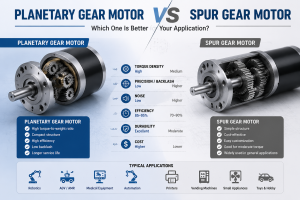
Table of Contents
- What Is a Planetary Gear Motor?
- What Is a Spur Gear Motor?
- Planetary Gear Motor vs Spur Gear Motor: Working Principle Comparison
- Key Performance Differences
- Torque and Load Capacity Comparison
- Efficiency and Lifetime Analysis
- Backlash and Precision Comparison
- Noise and Mechanical Design Considerations
- Application Comparison
- How to Choose Between Planetary and Spur Gear Motors?
- FAQ About Planetary and Spur Gear Motors
1. What Is a Planetary Gear Motor?
A planetary gear motor is a high-performance gear reduction system consisting of:
- Sun gear
- Planet gears
- Ring gear
- Planet carrier
The sun gear is connected to the motor shaft. When the motor rotates, it drives multiple planet gears that rotate inside the ring gear. The load is distributed among several gears simultaneously.
This unique structure allows a planetary gearbox to achieve:
- High torque output
- Compact size
- High efficiency
- Excellent load distribution
- Improved mechanical stability
A DC planetary gear motor is widely used where high torque and reliability are required.
Typical applications include:
- Robotic joints
- AGV and AMR robots
- Medical equipment
- Industrial automation
- Electric actuators
2. What Is a Spur Gear Motor?
A spur gear motor uses straight-cut cylindrical gears arranged in a series of gear stages.
The structure is relatively simple:
- Motor pinion gear
- Spur gears
- Output shaft
Each gear directly transfers rotational force to the next gear.
Advantages of spur gear motors include:
- Simple construction
- Lower manufacturing cost
- Easy customization
- Good availability
Because of their straightforward design, spur gear motors are commonly used in cost-sensitive applications requiring moderate torque and speed control.
Typical applications include:
- Automatic dispensers
- Small appliances
- Printers
- Toys
- Consumer electronics
3. Planetary Gear Motor vs Spur Gear Motor: Working Principle Comparison
The biggest difference between planetary and spur gear systems is the way torque is transmitted.
Planetary Gear System
Torque is transferred through multiple planet gears simultaneously.
Advantages:
- Multiple contact points
- Better force distribution
- Higher torque capacity
- Reduced gear stress
Spur Gear System
Torque is transferred through one gear contact point at each stage.
Advantages:
- Simple structure
- Easy production
- Lower cost
However, concentrated loading increases tooth stress when operating under high torque conditions.
4. Key Performance Differences
The following table summarizes the major differences:
| Parameter | Planetary Gear Motor | Spur Gear Motor |
| Torque Density | Excellent | Moderate |
| Efficiency | 85–95% | 70–90% |
| Size | Compact | Larger for same torque |
| Load Capacity | High | Medium |
| Backlash | Low | Higher |
| Noise | Lower | Higher |
| Cost | Higher | Lower |
| Lifetime | Longer | Moderate |
5. Torque and Load Capacity Comparison
Torque capability is one of the biggest advantages of planetary gear motors.
Why Planetary Gear Motors Provide Higher Torque
Because multiple planet gears share the load, the gearbox can handle higher mechanical stress.
For example:
A planetary gearbox with three planet gears distributes the load across three contact areas instead of one.
This provides:
- Higher output torque
- Better shock resistance
- Longer service life
For applications requiring a high torque gear motor, planetary technology is usually the preferred choice.
Spur Gear Motor Torque Characteristics
Spur gear motors can provide sufficient torque for many low and medium-load applications.
However, when torque requirements increase:
- Gear teeth experience higher stress
- Wear increases
- Noise becomes more noticeable
Therefore, spur gear motors are generally more suitable for applications where cost and simplicity are priorities.
6. Efficiency and Lifetime Analysis
Efficiency directly affects energy consumption and heat generation.
Planetary Gear Motor Efficiency
A well-designed planetary gearbox can achieve:
- 85–95% efficiency
Benefits:
- Lower power consumption
- Less heat generation
- Better continuous operation capability
Spur Gear Motor Efficiency
Spur gear systems typically achieve:
- 70–90% efficiency
Efficiency decreases as:
- Gear stages increase
- Load increases
- Gear wear occurs
For battery-powered applications, a planetary gear motor can provide longer operating time.
7. Backlash and Precision Comparison
Backlash refers to the small movement caused by clearance between gear teeth.
It directly affects:
- Position accuracy
- Repeatability
- Motion stability
Planetary Gear Motor
Advantages:
- Lower backlash
- Better positioning accuracy
- Suitable for closed-loop control
Applications:
- Robot arms
- CNC systems
- Precision medical devices
Spur Gear Motor
Advantages:
- Lower cost
Limitations:
- More mechanical clearance
- Reduced positioning accuracy
Suitable for:
- Simple rotating mechanisms
- Non-critical positioning systems
8. Noise and Mechanical Design Considerations
Noise is an important factor in modern products such as:
- Smart locks
- Electric curtains
- Medical devices
- Home automation products
Planetary Gear Motor Noise
The distributed gear contact reduces vibration and impact, resulting in smoother operation.
Spur Gear Motor Noise
Straight teeth create sudden engagement between gears, which can generate:
- Gear impact noise
- Vibration
- Mechanical resonance
For quiet products, planetary or optimized helical gear solutions are often preferred.
9. Application Comparison
Robotics
Recommended:
Planetary Gear Motor
Reasons:
- High torque-to-weight ratio
- Low backlash
- High reliability
Used in:
- Robotic arms
- Robot joints
- Humanoid robots
AGV / AMR Robots
Recommended:
Planetary Gear Motor
Reasons:
- Heavy load capability
- Continuous operation
- Shock resistance
Smart Home Devices
Application requirements:
- Low noise
- Compact size
- Moderate torque
Both solutions can be used.
Examples:
- Electric curtains
- Smart locks
- Automatic blinds
Consumer Products
Recommended:
Spur Gear Motor
Reasons:
- Lower cost
- Simple design
- Easy mass production
Examples:
- Small appliances
- Toys
- Mini mechanisms
10. How to Choose Between Planetary and Spur Gear Motors?
Engineers should evaluate the following factors:
1. Required Torque
Choose planetary gear motors when:
- Torque > several N·m
- Load changes frequently
- Shock loads exist
Choose spur gear motors when:
- Torque requirement is low or moderate
2. Operating Time
For continuous operation:
Recommended:
Planetary Gear Motor
Because it provides:
- Better thermal performance
- Longer lifetime
3. Precision Requirement
Choose planetary gear motors for:
- Position control
- Encoder feedback
- Robotic motion
4. Cost Requirement
Choose spur gear motors when:
- Budget is limited
- Performance requirements are moderate
11. Custom Gear Motor Solutions for OEM Applications
Different products require different motor characteristics.
A professional DC gear motor manufacturer can customize:
- Gear ratio
- Output torque
- Motor voltage
- Shaft design
- Encoder configuration
- Noise optimization
- Mounting dimensions
For OEM applications, motor selection should consider the complete system rather than only gearbox type.
A proper engineering evaluation includes:
- Load analysis
- Speed requirement
- Duty cycle calculation
- Mechanical integration
- Reliability testing
FAQ About Planetary Gear Motor vs Spur Gear Motor
Q1: Which is better, planetary gear motor or spur gear motor?
Neither is universally better. Planetary gear motors are better for high torque, precision, and continuous operation. Spur gear motors are better for cost-sensitive applications requiring simple motion control.
Q2: Why are planetary gear motors more expensive?
Planetary gearboxes require more precision manufacturing because multiple gears must work together with accurate alignment and load distribution.
Q3: Are planetary gear motors more efficient than spur gear motors?
Generally yes. Planetary gear motors usually provide higher efficiency because of better load distribution and optimized gear engagement.
Q4: Which gear motor is better for robotics?
A planetary gear motor is usually preferred for robotics because robots require high torque density, low backlash, and reliable operation.
Q5: Can a spur gear motor replace a planetary gear motor?
Only if the torque, speed, lifetime, and precision requirements are within the spur motor’s capability. For high-performance applications, replacing planetary with spur may reduce system reliability.
Conclusion
The choice between a planetary gear motor vs spur gear motor depends on application requirements, not simply cost or size.
A planetary gear motor is the ideal solution for applications requiring:
- High torque
- Compact design
- Precision control
- Long lifetime
A spur gear motor is suitable for applications requiring:
- Low cost
- Simple structure
- Moderate performance
For robotics, automation equipment, medical devices, and high-end OEM products, planetary gear motors usually provide better long-term value. For simple consumer mechanisms, spur gear motors remain an economical and practical choice.
Choosing the correct gearbox technology is the key to achieving reliable, efficient, and durable motion performance.
This information is shared by DongMing Motor(https://www.szdmdcmotor.com/)