
Planetary Gear Motor vs. Spur Gear Motor: A Complete Comparison of Torque, Speed, Efficiency, Service Life, Noise, Structure and Applications
When engineers select a DC gear motor for automation equipment, vending machines, electric curtains, smart locks, medical equipment, robotics, valves, pumps, or industrial actuators, planetary gear motors and spur gear motors are two of the most common options.
Both combine an electric motor with a reduction gearbox. The basic purpose is the same: reduce motor speed and increase usable output torque. However, their gearbox structures are fundamentally different, which affects torque capacity, torque density, speed capability, efficiency, backlash, noise, service life, size, cost, and application suitability.
This article compares planetary gear motor and spur gear motors from an engineering and OEM-selection perspective, based on the websites you provided plus additional web research. Some of the supplied sites were not directly accessible to the web crawler, so their individual claims could not be independently verified; I have not presented inaccessible material as verified fact.
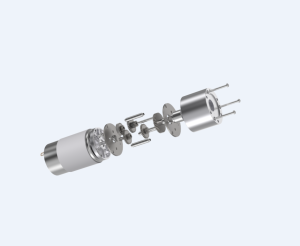
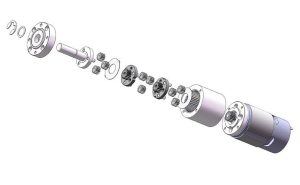
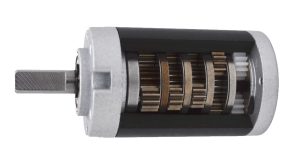
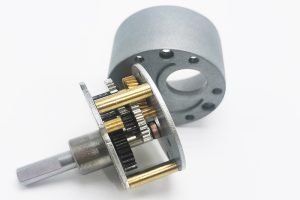
DC Planetary Gear Motor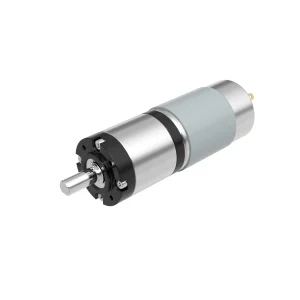 DC Spur Gear Motor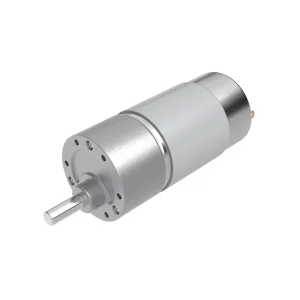
1. Planetary Gear Motor vs. Spur Gear Motor at a Glance
| Feature | Planetary Gear Motor | Spur Gear Motor |
| Basic structure | Sun gear + planet gears + ring gear + carrier | Straight-tooth gears on parallel shafts |
| Shaft arrangement | Coaxial / inline | Parallel / offset |
| Load distribution | Multiple gear meshes | Mainly one gear-pair mesh per stage |
| Torque density | High | Moderate |
| Output torque | High for its size | Moderate to high depending on size |
| Speed capability | Good for high-speed/high-torque applications | Good, but application-dependent |
| Efficiency | High | High, especially simple stages |
| Backlash | Low-backlash versions available | Usually higher/cumulative |
| Noise | Generally smoother/quieter when well designed | Can be more noticeable at high speed |
| Shock-load capability | Generally strong | Lower at comparable size |
| Size efficiency | Excellent | Good |
| Cost | Higher | Lower |
| Manufacturing complexity | High | Low |
| Maintenance | More specialized | Relatively simple |
| Precision positioning | Very suitable | Suitable for less demanding applications |
| Typical applications | Robotics, medical, automation, AGV, precision actuators | Vending, appliances, locks, dispensers, basic automation |
These are general tendencies, not absolute rules. Gear material, tooth profile, number of stages, lubrication, bearing design, manufacturing tolerances, load, speed, temperature, and duty cycle can change the actual performance of an individual gearbox.
2. What Is a Planetary Gear Motor?
A planetary gear motor combines a DC or BLDC motor with a planetary gearbox.
The basic planetary gearbox consists of:
- Sun gear
- Planet gears
- Ring gear
- Planet carrier
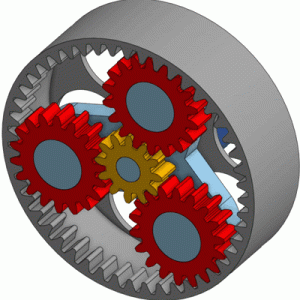
The motor drives the central sun gear. The sun gear drives several planet gears, and the planet gears mesh with the internal ring gear. Depending on which member is fixed, input, or output, different speed ratios can be obtained.
A simplified structure is:
Ring Gear
┌───────────────────┐
│ ○ Planet │
│ ↓ │
│ ● Sun │
│ ↑ │
│ ○ Planet │
│ │
└───────────────────┘
│
Planet Carrier
│
OUTPUT
The most important feature is that multiple planet gears can share the transmitted load simultaneously. This is the fundamental reason planetary gearboxes can achieve high torque density in a compact package.
Planetary gearboxes also normally have coaxial input and output shafts, which makes them attractive when the motor and output shaft need to remain on the same center line.
3. What Is a Spur Gear Motor?
A spur gear motor combines a DC or BLDC motor with a conventional spur gear train.
Spur gears have straight teeth parallel to the rotational axis. Several gears are mounted on parallel shafts and mesh with each other.
For example:
Motor
↓
Small Gear
↓
Large Gear
↓
Small Gear
↓
Large Gear
↓
Output
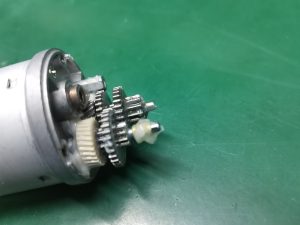
If a small gear drives a larger gear, speed decreases while torque increases.
The overall reduction ratio is determined by the gear tooth relationships and the number of stages.
The basic structure is comparatively simple, which makes spur gear motors relatively economical and easy to manufacture. ISL describes spur gear motors as cost-effective solutions particularly suited to lower torque and speed requirements.
4. Torque: Planetary Gearbox vs. Spur Gearbox
Torque density is one of the biggest differences between the two technologies.
A spur gearbox generally transfers load through one primary gear-tooth mesh at a time. Therefore, the load is relatively concentrated at that mesh.
A planetary gearbox uses multiple planet gears:
Planet
↓
Sun Gear → Planet Carrier
↑
Planet
The load is distributed among multiple contact points. This allows the gearbox to handle higher torque within a similar outer diameter when the gearbox is properly designed.
The multiple contact points allow planetary gear motors to sustain higher loads, load sharing reduces the pressure on individual gears.
This does not mean every planetary motor has higher absolute torque than every spur motor. A physically larger spur gearbox can produce more torque than a small planetary gearbox. The meaningful comparison is usually torque relative to gearbox size and weight.
5.Speed: Which One Is Better?
Planetary gear motors are particularly useful when an application requires a combination of:
high input speed + high output torque + compact dimensions.
The multiple load paths and coaxial structure make planetary gearboxes attractive for demanding high-speed/high-torque applications. DONGMING specifically identifies planetary gear motors as suitable for high-speed, high-torque applications. Spur gear motors can also operate efficiently at relatively high speeds, but their suitability depends heavily on gear quality, lubrication, bearing design, and reduction ratio.
Therefore, it is better to say:
High torque + high speed + compact package → planetary is often advantageous
Moderate torque + cost-sensitive design → spur is often sufficient
The actual maximum RPM must always come from the specific gearbox specification.
6. Gearbox Structure and Operating Principle
Spur gearbox
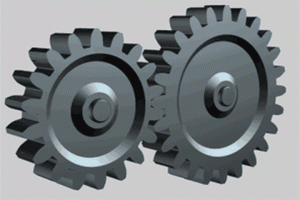
The operating principle is relatively straightforward:
Output Speed≈Motor Speed Gear Ratio Output\ Speed \approx \frac{Motor\ Speed}{Gear\ Ratio}
and approximately:
Tout=Tmotor×i×ηT_{out}=T_{motor}\times i\times\eta
where:
- ToutT_{out} = output torque
- TmotorT_{motor} = motor torque
- ii = reduction ratio
- η\eta = gearbox efficiency
- Adding more spur stages increases the total reduction ratio.
Planetary gearbox
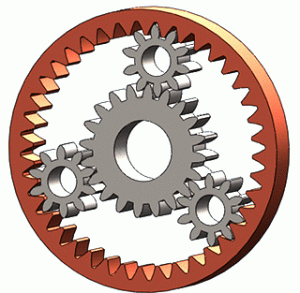
The planetary gearbox achieves reduction through the relative motion of the sun, planets, ring gear and carrier.
Multiple planetary stages can be stacked to obtain higher overall reduction ratios while retaining the coaxial architecture. DONGMING MOTOR, for example, offers planetary configurations from one through five stages in some product families.
This is an important advantage when a designer needs a high reduction ratio without creating an excessively wide or offset transmission system.
7. Efficiency
Both gearbox types can have high efficiency, but it is dangerous to say that planetary is always more efficient.
The actual efficiency depends on:
- Number of stages
- Gear ratio
- Gear tooth geometry
- Gear material
- Lubrication
- Bearing losses
- Input speed
- Output load
- Manufacturing accuracy
A well-designed spur gearbox can be extremely efficient, while a well-designed planetary gearbox can also provide excellent efficiency together with much higher torque density.
When choosing a motor, always compare the actual manufacturer’s efficiency curve or rated efficiency rather than relying only on gearbox type.
8. Service Lifetime and Durability
Planetary gearboxes have an important mechanical advantage: load sharing.
Instead of concentrating the entire transmitted load on one gear mesh, several planet gears participate in transmitting torque. This can reduce the stress on individual gear teeth when the gearbox is correctly designed.
That can make planetary designs attractive for:
- Continuous operation
- Frequent starting and stopping
- Repeated acceleration/deceleration
- Shock loads
- High output torque
However, gearbox type alone does not determine service life.
A motor’s actual life can depend on:
- Rated torque
- Peak torque
- Stall torque
- Duty cycle
- Start/stop frequency
- Gear material
- Gear hardness
- Bearing life
- Lubrication
- Temperature
- Radial load
- Axial load
- Shock load
- Manufacturing quality
A properly designed spur gearbox operating at a moderate load can have an excellent service life, while an overloaded planetary gearbox can fail quickly.
So for OEM projects, the best practice is to specify cycle life under the actual load and duty cycle rather than simply requesting a generic lifetime.
9. Noise and Vibration
Noise is another important difference.
Spur gears have straight teeth, and tooth engagement can generate noticeable gear-mesh noise, particularly at higher speeds or under higher loads.
DONGMING specifically notes that spur gear motors can become noisy at higher speeds if lubrication is inadequate.
Planetary gearboxes have multiple simultaneous gear meshes and a symmetrical architecture. This can provide smoother torque transmission and lower vibration when the gears and carrier are accurately manufactured. DONGMING Motor also describes planetary systems as having reduced vibration and noise compared with conventional designs.
But:
Planetary does not automatically mean silent.
Noise depends on:
- Gear accuracy
- Tooth profile
- Backlash
- Lubricant
- Bearing quality
- Housing resonance
- Motor commutation
- Operating RPM
- Load
A BLDC planetary motor can therefore be particularly quiet because both the motor and gearbox can contribute to smooth operation.
10. Backlash and Positioning Accuracy
Backlash is the angular clearance between mating gears.
It becomes especially important when the motor repeatedly changes direction:
Forward
↓
Stop
↓
Reverse
↓
Small angular movement before load responds
Planetary gearboxes can be manufactured with low-backlash and precision configurations, making them attractive for robotics, servo systems, medical devices, CNC equipment and precision actuators. DONGMING, for example, offers separate regular, precision and high-performance planetary gearbox series with different backlash/positioning characteristics.
Spur gearboxes generally accumulate backlash across multiple gear meshes.
However, it is important to avoid saying that every planetary gearbox has low backlash. Standard planetary gearboxes can also have significant backlash. The datasheet’s actual backlash specification is what matters.
11. Size and Packaging
This is another major difference.
Planetary
Motor
│
│
▼
┌──────────────┐
│ Planetary │
│ Gearbox │
└──────┬───────┘
│
▼
Output
Input and output are normally coaxial.
Spur
Motor
│
▼
┌───────┐
│ Gear │──── Gear
└───────┘
│
▼
Output
The shafts are generally parallel and offset.
This means planetary is attractive when:
The available radial diameter is limited but high torque is required.
Spur gearboxes can be attractive when:
The application can accommodate an offset shaft arrangement and cost is important.
Planetary gear motor construction can result in a longer, narrower package compared with some spur designs, so designers should compare the complete 3D envelope, not just gearbox diameter.
12. Advantages and Disadvantages
Planetary Gear Motor Advantages
- High torque density
- Compact coaxial architecture
- Multiple load paths
- High load capacity
- Good shock-load capability
- Low-backlash versions available
- Good precision potential
- Smooth operation
- Suitable for demanding duty cycles
- Excellent for compact high-torque systems
Planetary Gear Motor Disadvantages
- Higher cost
- More components
- More complicated manufacturing
- Higher assembly precision requirements
- More difficult maintenance
- More demanding gear alignment
- Potentially greater thermal concentration because of compact packaging
- Higher complexity and cost as important trade-offs of planetary designs.
Spur Gear Motor Advantages
- Simple construction
- Lower cost
- Easy to manufacture
- Easy assembly
- Easy maintenance
- High efficiency in suitable configurations
- Good solution for moderate loads
- Suitable for high-volume production
- Many standard ratios available
- Good choice for cost-sensitive products
Spur Gear Motor Disadvantages
- Lower torque density
- Load concentrated at gear mesh
- Generally greater backlash
- More noticeable gear-mesh noise
- More sensitive to misalignment
- High reduction ratios can require multiple stages
- High shock loads can be demanding on individual gear teeth
13. Typical Applications
Planetary Gear Motor Applications
Planetary gear motors are commonly used in:
- Robotics
- AGV/AMR
- Industrial automation
- Medical equipment
- Precision actuators
- Servo systems
- Electric valves
- Surgical equipment
- Compact lifting systems
- High-torque BLDC drives
- Precision positioning mechanisms
DONGMING identifies robotics, servo systems, semiconductor equipment and medical devices among applications for its precision planetary gearboxes.
Spur Gear Motor Applications
Spur gear motors are particularly useful for:
- Vending machines
- Snack dispensing
- Beverage machines
- Paper towel dispensers
- Electric locks
- Small appliances
- Printers
- Packaging equipment
- Small conveyors
- Simple actuators
- General automation
DONGMING specifically lists automated paper towel dispensers, electromechanical door locks, small appliances and other lower-demand mechanisms among its spur gear motor applications.
For example, a 12V or 24V DC spur gear motor for a vending machine spiral usually does not need the same torque density or precision as a robotic actuator. In such a situation, the simpler gearbox can provide a better cost/performance balance.
14. Planetary vs. Spur: Which One Should You Choose?
The selection should start with the application’s actual requirements rather than asking which technology is universally better.
Choose a planetary gear motor when:
- Output torque is high
- Installation space is limited
- Torque density is important
- Shock loads are significant
- Backlash must be controlled
- Positioning accuracy matters
- The motor runs frequently
- A coaxial output is desirable
- Long-term demanding operation is required
- Choose a spur gear motor when:
- Cost is a major consideration
- Torque requirements are moderate
- The load is predictable
- The application is intermittent
- Precision positioning is not critical
- A parallel/offset shaft is acceptable
- Easy manufacturing and maintenance are important
- The product will be manufactured in high volume
DONGMING summarizes the basic selection logic similarly: tight space, high torque and precision favor planetary, while cost and simpler maintenance favor spur.
15. Final Conclusion
The key difference between a planetary gear motor and a spur gear motor is not simply the number of gears—it is the way the gearbox carries and distributes mechanical load.
A spur gear motor uses relatively simple parallel-shaft gear pairs. This gives it important advantages in cost, manufacturing simplicity, maintenance and efficiency, making it highly suitable for moderate-load and cost-sensitive products.
A planetary gear motor uses a sun gear, multiple planet gears, a ring gear and a carrier. Its multiple load paths provide higher torque density, compact coaxial packaging, better shock-load capability and strong potential for low-backlash precision motion. The trade-off is greater manufacturing complexity and generally higher cost.
The practical selection can therefore be summarized as:
Planetary Gear Motor = High Torque + High Torque Density + Compact + Precision + Heavy Duty
Spur Gear Motor = Simple + Economical + Efficient + Moderate Load + Cost-Effective
Neither technology is universally superior. The correct choice depends on output torque, output speed, reduction ratio, duty cycle, gearbox size, backlash, noise, service life, shock load, shaft loading, operating temperature, control requirements and target cost.
For small 6V/12V/24V DC gear motors, this distinction is particularly important. A 12V spur gear motor can be an excellent solution for a vending-machine dispenser or simple actuator, while a 12V/24V planetary gear motor may be more appropriate for a compact high-torque actuator, robotic mechanism, medical device, or precision automation system. DONGMING’s current product/application information illustrates this same division, with spur products positioned toward economical lower-demand applications and planetary products toward high-torque, compact and precision-oriented applications.