

Air Purifier
An air purifier is a device used to improve indoor air quality by filtering and purifying pollutants in the air, such as dust, pollen, smoke, bacteria and viruses.
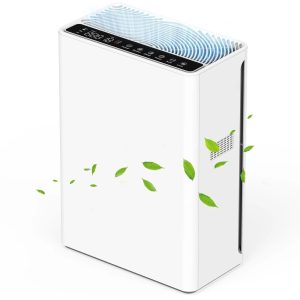
Its core functions include:
Air intake: Air is drawn into the device through a built-in fan.
Filter system: The air is filtered through multiple layers, including pre-filter, HEPA filter, activated carbon filter, etc., to remove different types of pollutants.
Purification technology: Some air purifiers use ionization or ultraviolet disinfection technology to further purify the air.
Intelligent control: Air quality is monitored through sensors and the operating mode is automatically adjusted as needed.
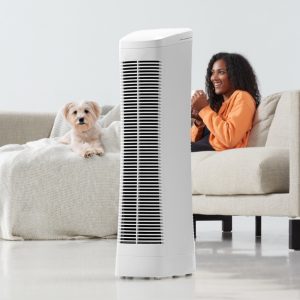
How our motor works in the product:
Driving the fan: The motor drives the fan, which draws air into the device and pushes it through the filtration system.
Precise control: The motor cooperates with the controller to automatically adjust the fan speed according to the air quality data fed back by the sensor to ensure the best purification effect.
Energy-saving operation: At low pollution levels, the motor can enter low power mode to reduce energy consumption.
Quiet Operation: The motor is designed to operate with low noise, ensuring it will not cause any disturbance when used in home and office environments.
Below: the engineering behind this application, and which of our frames cover it.
An air purifier motor runs slowly, quietly, for years
Nothing about an air purifier asks for much torque. What it asks for is that the motor be inaudible in a bedroom at night and still be inaudible after three years of continuous running. That makes this one of the few applications where the specification is almost entirely about noise, bearing life and low-speed behaviour rather than about load.
Most units have two motor duties: the main fan, which runs continuously and is the one the customer hears, and a small damper or oscillating louvre that moves occasionally. Occasionally, on this application, means a few thousand times over a product life — enough that a poorly matched damper motor becomes a warranty item.
Noise at low speed is a different problem from noise at rated speed
Purifiers spend most of their life in a low or sleep mode, at a fraction of maximum speed. Gear mesh and bearing noise do not scale down with speed the way air noise does, so a motor that is inaudible at full speed can be the dominant sound at 300 RPM. The measurement that matters is taken at the sleep-mode speed, at the user’s distance, not at rated speed on a bench.
There is a second trap in sleep mode: the drive is often running the motor far below its efficient point, which means more current per unit of output and less self-cooling. Thermal margin at low speed has to be checked separately.
What we specify for purifier motors
- Noise at sleep-mode RPM — the number that decides the product, and it has to be measured at that speed.
- Bearing type and lubricant — continuous duty for years is a bearing life question before a motor question.
- Cogging and low-speed smoothness — a brushless frame with low cogging avoids the tick users notice at low speed.
- Thermal margin at low speed — less airflow over the motor when the fan is slow.
- Damper duty cycle — thousands of small moves, so breakaway torque and clutch behaviour matter more than rated torque.
- Supply quality — purifiers often share a circuit with other electronics; a motor tolerant of a noisy rail avoids random stalls.
Failure modes on air purifiers
Audible gear whine in sleep mode. Gear pitch and lubricant chosen for the rated speed. This is fixable at sample stage and almost impossible to fix after tooling, so specify the sleep-mode speed up front.
Bearing rumble after two years of continuous running. Life is quoted in hours at a load; a purifier runs 24 hours a day, which is 8760 hours a year. Ask for the life figure at your continuous load, not at rated torque.
Damper sticks. Dust on the pivot after a season. A slipping clutch or stall retry saves the motor and the warranty.
Frames for fan and damper duties
Small planetary frames for the damper and louvre, low-cogging brushless frames for the fan. Figures from the current datasheets.
- DM-24PBL2418 — 24 mm, 6-24 VDC, 3-1500 RPM, 0.5-7 kg.cm
- DM-22PBL2230 — 22 mm, 6-24 VDC, 3-1500 RPM, 0.5-7 kg.cm
For the main fan, the frame is usually chosen to fit the impeller housing, then run below rated torque so that noise and life both improve. Tell us the target dB(A) and the housing, and we will say which frame reaches it.
Questions from purifier designers
How quiet is it at 300 RPM? We will measure at the speed you specify rather than quote the rated-speed figure, because on this application the rated-speed figure is misleading.
What is the bearing life at continuous duty? Give us the run hours per day and the load; the answer is a calculation, not a catalogue line.
Can the damper motor survive a stall? We will give you the breaking torque so the drive can limit current below it, and we can discuss a clutch if the flap is likely to jam.