

Vending Machine
 Nowadays,you can find the automatic vending machines in everywhere, mall, street, scenic spot, park, etc.There are various type of vending machines including coffee, snacks, drink, soda pop machines, ice cream, etc. In recent years, the demand for vending machines has continued to grow, and the epidemic situation has accelerated the growth of the vending machine industry. An automatic vending machine automatically dispenses the snack or beverage. Just like most things, automatic vending started off rather simple. The vending machines began with inserting change into a machine and turning a dial to open a flap. Then they evolved into super complex refrigerated machines with elevator lift capabilities, accepting all forms of payment, including apple pay, credit cards, cash and other various forms of payment as well.
Dongming’s DC Gearbox Motor Solution for Vending Machine
Dongming’s DC gearbox motors are applied on multi-functions in vending machines, such as lift, coin collection, coin operator, banknotes collection, banknotes acceptor, automatic change giving, dispensing items automatically.Vending machines can be seen everywhere in our lives. Vending machines have a wide range of applications, such as beverage vending machines, food vending machines, coffee vending machines, coin-operated lockers, automatic parking payment machines, automatic food ordering machines, and cashing machines, Coin machines, mask vending machines, Automatic Pay Station, Ticket Vending Machine and withdrawal machines, self-service ordering machine, claw crane, coin pusher machine, claw machine. Today, we just introduce one function application for our DC gear motor. It is lift or elevator of snack, drink vending machine. The important point is that the auto lift vending machine requires high torque and low noise for DC gear motor.
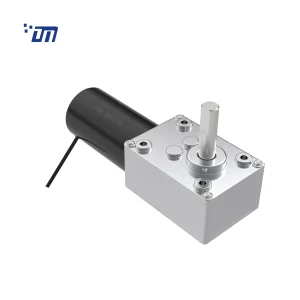
Many customers use our planetary gear motor DM-36RP series, DM-42RP series, Round Spur gearbox motor DM-37RS, DC square spur gearbox DM-95SS series, Right Angle gearbox motor DM-58SW series.
Below: the engineering behind this application, and which of our frames cover it.
What a vending machine gearmotor actually has to survive
A snack or drink vending machine looks like a simple machine and is not. Inside one cabinet you have four or five separate motor duties: the XY gantry or spiral that releases the product, the elevator tray that carries it down, the coin and bill path, and the door lock. Each one fails differently, and each one is bought against a different number. Treating them as one motor specification is the most common reason a prototype passes and a field unit does not.
The elevator tray is the hardest duty. It has to hold a loaded tray at rest without back-driving, start against static friction every time, and stop within a millimetre of the target shelf. Holding torque and breakaway torque, not rated torque, decide whether it works.
Size the torque before you size the ratio
The number that matters is the torque needed to lift the tray plus its load, taken at the pulley radius, multiplied by a safety factor for breakaway and for the tray running slightly off level. A tray that is 2 kg empty and 5 kg loaded on a 20 mm pulley needs roughly 1 kg.cm just to hold the load, and three to five times that to start reliably and to absorb the moment when a heavy item shifts.
Only once that figure is fixed does the gear ratio make sense. Pick the ratio for the speed you need, then confirm the resulting torque sits inside the motor’s continuous band rather than its peak. A ratio chosen for speed and then pushed to meet torque is how gearboxes get their teeth stripped.
The parameters that actually decide the part
- Holding torque at zero speed — decides whether the tray creeps when the machine is idle.
- Breakaway torque — usually 1.5 to 2 times running torque; undersizing this is the classic cold-morning failure.
- Noise at the customer’s ear — a drink machine in a hotel lobby is specified at a different level than one in a factory canteen.
- Duty cycle — tray motors run in short bursts, coin path motors run continuously; they are not the same motor.
- Supply tolerance — a 24 V rail that sags to 21 V under load still has to start the tray.
- Shaft and coupling — a D-cut or keyed shaft designed together with the pulley avoids a set-screw that slips after a thousand cycles.
Where these motors fail in the field
Stripped first-stage gear. Almost always a jam, not a design flaw: the tray meets an obstruction and the motor keeps pushing. The fix is a current limit in the drive, set below the gearbox’s breaking torque, rather than a bigger gearbox.
Tray creep overnight. Insufficient holding torque, or a gearbox with too much back-drive. A worm gearbox or a high-ratio planetary holds far better than a low-ratio spur unit of the same size.
Audible whine after a few months. Grease migrating away from the first stage, usually caused by mounting the gearbox in an orientation it was not lubricated for. Confirm mounting orientation with us before the first production run.
Motors we build in the torque band this application needs
All figures below are from the current datasheets, not a generic table — follow the link on any model for its full curve, dimensions and 3D drawing.
- DM-36PBL3626 — 36 mm, 12-24 VDC, 3-1500 RPM, 1-30 kg.cm
- DM-42PBL4260 — 42 mm, 12-24 VDC, 4-800 RPM, 1-62 kg.cm
- DM-58WM31ZY — 12-24 VDC, 2-120 RPM, 0.6-30 kg.cm
- DM-95SM545 — 37.6 mm, 12-24 VDC, 2.5-137 RPM, 1-100 kg.cm
For the coin and bill path, where torque is low and speed is high, the same catalogue covers it from the 12 mm to 28 mm frame sizes. Both ends usually ship from one supplier, which keeps the approval and the incoming inspection to a single set of documents.
Questions we get from vending machine integrators
Can you supply the gearbox and motor as one unit with the pulley fitted? Yes — shaft, pulley and coupling are part of the customization scope, so the assembly arrives keyed and does not depend on a set screw.
Do you have an encoder option for tray positioning? Magnetic Hall encoders are available on the brushless frames, and they are what most tray designs use to find the home position without a limit switch.
What is the lead time for a first sample? Samples are built to your voltage, ratio and shaft spec; ask us for the current lead time with your target quantity so the answer is specific rather than a range.