
How Micro DC Motors Drive Smart Home Automation
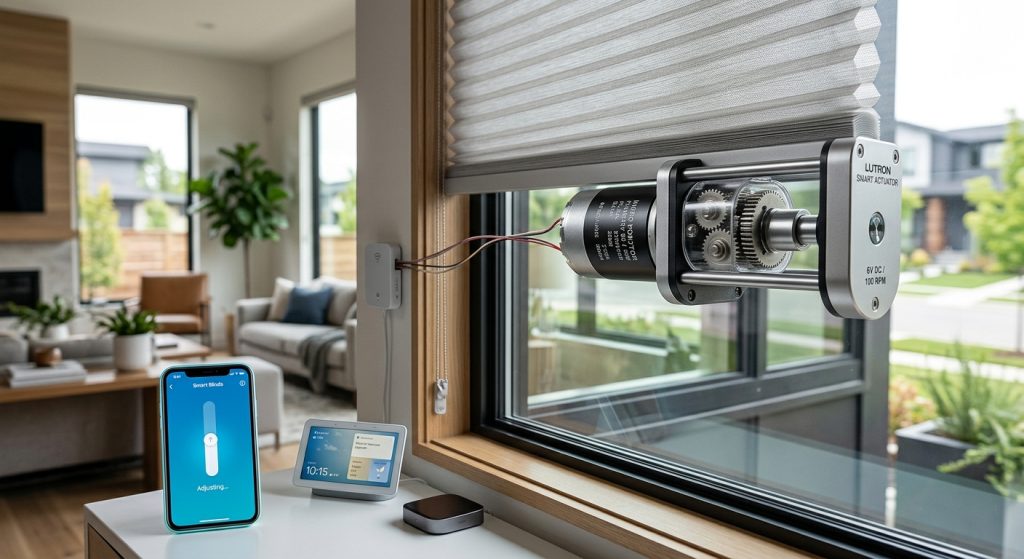
Micro DC motors serve as the silent workhorses behind modern smart home automation systems, converting electrical energy into precise mechanical movement. From motorization of window blinds and automated door locks to smart valves and robotic vacuums, selecting the right micro DC motor determines system reliability, noise levels, and energy efficiency.
Primary Applications in Smart Home Infrastructure
| Smart Home Device | Core Motor Requirement | Typical Micro Motor Solution | Key Performance Indicator |
| Smart Door Locks | High peak torque, low standby power | Brushless or Coreless Micro DC Gear Motor | Mechanical lock bolt engagement force |
| Automated Blinds & Shades | Quiet operation ($<35\text{ dB}$), compact diameter | Planetary Micro DC Gear Motor ($12\text{mm} – 25\text{mm}$) | Smooth vertical lifting capacity & acoustic profile |
| Robotic Vacuum Cleaners | High RPM drive wheels, long continuous lifespan | High-Efficiency Brushless DC (BLDC) Motor | Duty cycle durability & battery power consumption |
| Smart HVAC Valves | Precise positional repeatability | Small Stepper or Spur Micro Gear Motor | Exact fluid/air flow throttling control |
Engineering Selection Criteria for Automation Systems
When integrating micro DC motors into IoT and smart home products, design engineers must balance size constraints with electro-mechanical output:
Acoustic Noise Reduction: Residential environments require silent actuation. Using helical gear stages, plastic-metal hybrid gearboxes, or coreless micro motors significantly dampens operational vibration.
Torque-to-Volume Ratio: Space inside smart door locks and motorized curtains is extremely limited. Micro planetary gearheads maximize output torque while maintaining a slim cylindrical form factor.
Power Consumption & Battery Life: Most smart home devices rely on battery power or Low-Power Wi-Fi/Zigbee/Matter protocols. Motors with high operational efficiency ($\eta > 85\%$) extend replacement cycles.
Integrated Encoders for Smart Control: Combining micro DC motors with magnetic or optical encoders enables closed-loop feedback, allowing smart hubs to detect exact position, stall conditions, or physical blockages.
Procurement & Integration Checklist
Specify Rated vs. Stall Torque: Ensure the normal continuous operating load does not exceed $20-30\%$ of the motor’s stall torque to avoid thermal degradation over long-term use.
Verify Ingress Protection (IP) Requirements: Smart outdoor locks or motorized valve actuators exposed to humidity require sealed gearbox housing and IP-rated shaft seals.
Evaluate Voltage Compatibility: Align motor voltage specifications (typically 3V, 6V, 12V, or 24V DC) with standard battery configurations or step-down power converters on the PCB.
Choosing the ideal micro DC gear motor ensures seamless user experiences, low warranty return rates, and prolonged operational life in next-generation automated home devices.
For more information, please visit 《What Are The Electric Motors Used In Household Appliances》
{acf_post_brief}