
DC Motor vs DC Gear Motor: Differences, Advantages and Applications
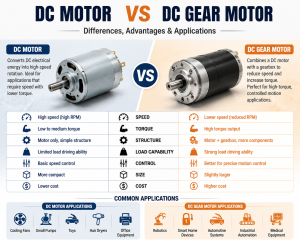
Table of Contents
- What Is a DC Motor?
- What Is a DC Gear Motor?
- DC Motor vs DC Gear Motor: Key Differences
- Advantages of DC Gear Motors
- Common Applications
- How to Choose the Right Motor?
- FAQ
1. What Is a DC Motor?
A DC motor is an electrical motor that converts direct current (DC) electrical energy into mechanical rotation.
The basic components include:
- Stator
- Rotor (armature)
- Permanent magnets or field winding
- Commutator and brushes (for brushed DC motors)
When current flows through the armature winding, a magnetic field is generated. The interaction between the rotor and stator magnetic fields produces rotational movement.
Main Characteristics of DC Motors:
High Speed
DC motors typically operate at high RPM, making them suitable for applications requiring fast rotation.
Simple Speed Control
Speed can be easily adjusted through:
- Voltage control
- PWM (Pulse Width Modulation)
Compact Structure
Small DC motors are widely used in:
- Fans
- Toys
- Small pumps
- Consumer electronics
However, a standard DC motor usually has limited torque output, especially at low speed.
2. What Is a DC Gear Motor?
A DC gear motor is a combination of a DC motor and a gearbox.
The gearbox reduces the motor speed and increases output torque.
The basic relationship is:
Output Torque = Motor Torque × Gear Ratio × Efficiency
For example:
A DC motor producing 0.05 Nm torque combined with a 100:1 gearbox can achieve approximately:
0.05 × 100 × efficiency ≈ 4–5 Nm output torque
This allows a small motor to move heavier loads.
Common gearbox types include:
Spur Gearbox
Advantages:
- High transmission efficiency
- Low cost
- Simple structure
Applications:
- Smart devices
- Office equipment
- Small automation systems
Planetary Gearbox
Advantages:
- High torque density
- Compact size
- High load capacity
- Low backlash
Applications:
- Robotics
- AGV robots
- Precision automation
Worm Gearbox
Advantages:
- High reduction ratio
- Self-locking capability
Applications:
- Electric curtains
- Smart locks
- Adjustable furniture
3. DC Motor vs DC Gear Motor: Key Differences
| Feature | DC Motor | DC Gear Motor |
| Speed | High speed | Lower controlled speed |
| Torque | Low to medium | High torque output |
| Structure | Motor only | Motor + gearbox |
| Load Capability | Limited | Strong load driving ability |
| Efficiency | High at high speed | Optimized for torque applications |
| Size | Smaller | Slightly larger |
| Cost | Lower | Higher |
| Control | Simple | Better for motion control |
The biggest difference is:
A DC motor is designed for speed, while a DC gear motor is designed for torque.
4. Advantages of DC Gear Motors
4.1 Higher Output Torque
The biggest advantage of a DC gear motor is its ability to produce high torque from a compact motor size.
This makes it suitable for:
- Mechanical movement
- Lifting systems
- Robotic joints
- Automated equipment
4.2 Better Load Handling
Many mechanical systems require stable operation under changing loads.
The gearbox provides:
- Increased mechanical advantage
- Better starting capability
- Improved load stability
For example, an automatic door system requires strong starting torque to overcome initial resistance. A standard DC motor may stall, while a DC gear motor can provide sufficient torque.
4.3 Precise Speed Control
Many applications require slow and stable movement.
A gearbox reduces motor speed and improves control accuracy.
Typical applications include:
- Smart locks
- Medical equipment
- Electric curtains
- Camera systems
4.4 Longer Mechanical Reliability
By operating at lower output speed, the gearbox reduces mechanical stress on the system.
Combined with proper bearing and gear design, DC gear motors can provide reliable long-term operation.
5. Common Applications
DC Motor Applications
Standard DC motors are commonly used in:
- Cooling fans
- Small pumps
- Electric toys
- Hair dryers
- Simple rotating devices
These applications usually require:
- High speed
- Low torque
- Simple operation
DC Gear Motor Applications
DC gear motors are widely used where torque and controlled motion are important.
Robotics
Applications:
- Robot wheels
- Robotic arms
- Grippers
Advantages:
- High torque
- Compact size
- Precise movement
Smart Home Devices
Applications:
- Smart locks
- Electric curtains
- Automatic blinds
Requirements:
- Low noise
- Stable speed
- Long lifespan
Automotive Systems
Applications:
- Electric tailgates
- Seat adjustment systems
- Window lifters
DC gear motors provide the required force while maintaining compact installation space.
Industrial Automation
Applications:
- Conveyor systems
- Packaging machines
- Automatic feeders
Benefits:
- Reliable operation
- High torque output
- Easy control integration
6. How to Choose Between a DC Motor and DC Gear Motor?
Engineers should consider several factors:
1. Required Torque
If the application needs:
- Starting torque
- Heavy load movement
- Mechanical force
A DC gear motor is usually the better choice.
2. Required Speed
Choose a standard DC motor when:
- High RPM is needed
- Load is small
- Torque requirement is low
Choose a DC gear motor when:
- Low speed is required
- Stable movement is important
3. Working Environment
Consider:
- Continuous operation time
- Noise requirements
- Installation space
- Load changes
4. Control Requirements
For applications requiring:
- Position control
- Speed feedback
- Precise movement
A DC gear motor with encoder feedback may be preferred.
7. FAQ
Q1: Is a DC gear motor stronger than a DC motor?
Yes. A DC gear motor provides higher output torque because the gearbox increases mechanical advantage.
Q2: Can a DC motor replace a DC gear motor?
Not always.
If the application requires high torque at low speed, replacing a gear motor with a standard DC motor may result in insufficient force or motor overheating.
Q3: Are DC gear motors energy efficient?
Yes, when correctly selected. They allow smaller motors to drive larger loads, reducing unnecessary power consumption.
Q4: What industries use DC gear motors?
DC gear motors are widely used in:
- Robotics
- Medical equipment
- Smart home products
- Automotive systems
- Industrial automation
Conclusion
The difference between a DC motor vs DC gear motor mainly comes down to their intended purpose.
A standard DC motor is ideal for high-speed, low-load applications, while a DC gear motor is designed for applications requiring high torque, controlled speed, and reliable mechanical movement.
For engineers developing robotics, automation equipment, smart devices, and industrial systems, selecting the correct motor type is essential for improving performance, efficiency, and product reliability.
A properly matched high torque DC gear motor can provide a compact, durable, and cost-effective motion solution for modern mechanical systems.
{acf_post_brief}