
Power Window Motor Technology and Complete Automotive Motor Solutions
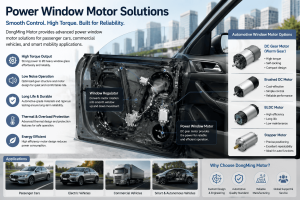
Table of Contents
- Introduction
- How Does a Power Window Motor Work?
- Types of Motors Used in Power Window Systems
- Key Technologies Behind High-Performance Power Window Motors
- How to Choose the Right Power Window Motor
- Power Window Motor Solutions for Different Automotive Applications
- DongMing Motor Customized Automotive Motor Solutions
- Future Trends in Power Window Motor Technology
- Conclusion
1. Introduction
Modern vehicles have evolved from simple transportation systems into intelligent platforms integrating comfort, safety, and automation technologies. Among various automotive comfort functions, the power window motor is one of the most frequently used electrical mechanisms in daily driving.
The heart of this system is the Power Window Motor, which converts electrical energy into mechanical movement to raise and lower vehicle windows smoothly and efficiently.
Although the window movement appears simple, the motor must overcome complex mechanical loads caused by:
- Window glass weight
- Friction from guide rails
- Seal resistance
- Temperature variations
- Vehicle vibration
- Repeated operating cycles
Therefore, automotive window motors require excellent torque capability, durability, low noise, and compact design.
At DongMing Motor, we develop customized Automotive DC Motor Solutions that help manufacturers achieve reliable, quiet, and efficient power window systems for passenger vehicles, commercial vehicles, and intelligent mobility platforms.
2. How Does a Power Window Motor Work?
A Power Window Motor operates by converting electrical energy from the vehicle battery into mechanical rotational motion.
The typical power window system consists of:
- DC motor
- Gear reduction mechanism
- Window regulator
- Control module
- Position sensors
- Mechanical guide system
When the driver presses the window switch, the control module supplies current to the motor. The motor rotates and transfers torque through the gearbox to the window regulator, converting rotational motion into vertical movement of the window glass.
Because automotive windows require high lifting force at relatively low speed, most systems use a DC Gear Motor rather than a direct-drive motor.
The gearbox increases output torque while reducing speed, enabling smooth and controlled window movement.
3. Types of Motors Used in Power Window Systems
Different vehicle platforms require different motor solutions.
Brushed DC Gear Motors
Brushed DC Gear Motors are widely used in automotive window systems because of their:
- High starting torque
- Simple control
- Compact structure
- Cost efficiency
- Proven reliability
The integrated gearbox allows the motor to generate sufficient force to lift heavy glass panels while maintaining smooth operation.
Brushless DC Motors (BLDC)
With the development of smart vehicles and electric vehicles, BLDC Motors are increasingly used in advanced automotive applications.
Advantages include:
- Longer lifetime
- Higher efficiency
- Lower maintenance
- Reduced electrical noise
- Better speed control
BLDC technology is especially suitable for premium vehicles requiring intelligent control and enhanced durability.
DC Worm Gear Motors
DC Worm Gear Motors are commonly used in power window applications because worm gears provide:
- High reduction ratio
- Compact structure
- Self-locking capability
- High output torque
The self-locking feature helps prevent the window from moving downward when power is removed.
4. Key Technologies Behind High-Performance Power Window Motors
Developing reliable Automotive Window Motors requires optimization of electrical, mechanical, and acoustic performance.
High Torque Density Design
A power window motor must generate sufficient torque within limited installation space.
Key design factors include:
- Optimized magnetic circuit
- High-performance permanent magnets
- Efficient winding design
- Compact gearbox integration
Higher torque density allows smaller motors while maintaining lifting performance.
Noise and Vibration Optimization (NVH)
Vehicle comfort standards continue to increase, making motor noise a critical design factor.
Noise sources include:
- Gear meshing noise
- Bearing vibration
- Electromagnetic vibration
- Rotor imbalance
Solutions include:
- Precision rotor balancing
- Low-noise gear design
- High-quality bearings
- Optimized motor structure
Thermal Management
Power window motors experience frequent short-duration overload conditions.
Effective thermal design improves:
- Motor lifetime
- Overload capability
- Operating reliability
Important factors include:
- Copper winding optimization
- Heat dissipation design
- Thermal protection
- Efficient magnetic materials
Durability and Lifetime Design
Automotive window motors must withstand thousands of operating cycles throughout vehicle life.
Reliability evaluation includes:
- Load cycle testing
- Temperature testing
- Vibration testing
- Humidity testing
- Stall operation testing
- Long-term endurance testing
5. How to Choose the Right Power Window Motor
Selecting the correct Power Window Motor requires evaluating the complete window system.
Important parameters include:
- Required lifting torque
- Window glass weight
- Operating speed
- Voltage platform
- Gear ratio
- Noise requirements
- Installation space
- Duty cycle
- Environmental conditions
- Expected lifetime
A properly matched motor improves:
- Window movement smoothness
- Energy efficiency
- Passenger comfort
- System reliability
6. Power Window Motor Solutions for Different Automotive Applications
Different vehicles require different motor characteristics.
Passenger Vehicles
Passenger cars prioritize:
- Low noise
- Smooth operation
- Compact size
- High reliability
DC gear motors are commonly used for front and rear door window systems.
Electric Vehicles (EVs)
Electric vehicles require highly efficient electrical components.
Advanced window motors focus on:
- Low power consumption
- Lightweight design
- Intelligent control compatibility
- Long service life
Commercial Vehicles
Trucks and buses require:
- Higher torque
- Strong durability
- Wide temperature operation capability
Heavy-duty window motors must withstand demanding environments.
Smart Vehicles and Autonomous Platforms
Future intelligent vehicles require:
- Sensor integration
- Automatic window control
- Anti-pinch protection
- Smart actuator systems
These applications benefit from advanced BLDC and integrated motor solutions.
7. DongMing Motor Customized Automotive Motor Solutions
DongMing Motor provides customized Automotive Motor Solutions for OEM and Tier suppliers.
Our engineering capabilities include:
- DC Gear Motors
- Brushed DC Motors
- BLDC Motors
- Worm gear solutions
- Planetary gear solutions
- Custom shaft designs
- Hall sensor integration
- Encoder solutions
- Low-noise optimization
- High torque-density design
- Automotive reliability testing
From prototype development to mass production, DongMing Motor works closely with customers to optimize:
- Torque performance
- Noise level
- Efficiency
- Durability
- Cost effectiveness
8. Future Trends in Power Window Motor Technology
Automotive window systems are becoming smarter as vehicles move toward electrification and automation.
Future trends include:
- Higher efficiency BLDC motors
- Integrated smart actuators
- Sensor-based position control
- AI-assisted vehicle comfort systems
- Lightweight motor designs
- Lower noise operation
- Improved energy efficiency
- Integrated safety functions
These technologies will enable quieter, smarter, and more reliable vehicle window systems.
9. Conclusion
The Power Window Motor is a small but essential automotive actuator that directly affects vehicle comfort, reliability, and user experience. Designing a high-performance window motor requires careful optimization of torque, gearbox design, noise control, thermal performance, and durability.
With extensive experience in miniature motor technology and precision drive systems, DongMing Motor provides customized Power Window Motor Solutions for automotive manufacturers and component suppliers worldwide.
By combining advanced motor design, precision manufacturing, and flexible OEM/ODM capabilities, DongMing Motor helps customers develop reliable and efficient automotive motion systems for next-generation vehicles.
FAQ
What type of motor is used for power windows?
Most vehicles use DC Gear Motors, especially brushed DC motors combined with worm gear reduction systems, because they provide high torque and compact size.
Why do power window motors need gear reduction?
The gearbox increases output torque and reduces speed, allowing the motor to lift heavy window glass smoothly.
Are BLDC motors suitable for automotive windows?
Yes. BLDC Motors provide longer lifetime, higher efficiency, and better control performance, making them suitable for advanced vehicle applications.
What factors affect power window motor performance?
Key factors include torque output, gear ratio, noise level, thermal performance, durability, and mechanical integration.
Can DongMing Motor customize automotive window motors?
Yes. DongMing Motor provides customized DC motors, gear motors, BLDC motors, and automotive motion solutions according to OEM requirements.
{acf_post_brief}