
DC Planetary Gear Motor
What is DC Planetary Gear Motor
DC planetary gear motors consist of a DC motor and a planetary gearbox. The function of DC planetary gear motor is to reduce the speed and increase the torque by means of planetary reduction drive structure. The most important parameters of a planetary gear motor are speed, torque, power, current and efficiency. Because of its high precision, high efficiency and long life, it is widely used in intelligent products in life. If you are still comparing gear types, the overview of what a DC gear motor is covers spur, worm and planetary options side by side.
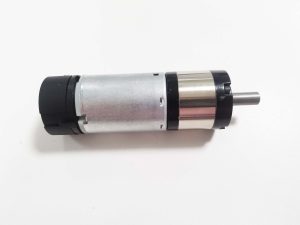
Construction of DC Planetary gear motor
It is composed of a central sun gear, planet gears mounted on a carrier plate, and a fixed outer ring gear. Because the sun teeth mesh with the teeth of multiple planetary gears at the same time, and the planetary teeth mesh with multiple ring teeth at the same time, planetary gear motors can withstand high loads. The number of reduction stages determines the size of the reduction ratio. The number of reduction gearbox stages can be 2, 3, 4, 5, 6, 7 and so on. The greater the number of stages, the higher the reduction ratio and the bigger the increase in torque.
How stages translate into ratio and efficiency
| Gear stages | Typical ratio range | Approx. overall efficiency | Typical use |
|---|---|---|---|
| 1 stage | 3-10 : 1 | ~95% | Compact drives, small appliances |
| 2 stages | 10-100 : 1 | ~90% | General automation, vending mechanisms |
| 3 stages | 30-300 : 1 | ~85% | Robot joints, AGV drive wheels |
| 4 stages | 100-1,000 : 1 | ~80% | High-torque, low-speed actuators |
| 5+ stages | up to ~2,000 : 1 | Sized case by case | Very slow, high-torque positioning |
Each planetary stage is typically 3-10:1, the cumulative ratio is the product of the stages, and every added stage costs a few percent of efficiency while lengthening the gearbox. Exact values depend on gear module, bearings and lubrication – always check the ratio table on the model page before freezing the gearbox length.
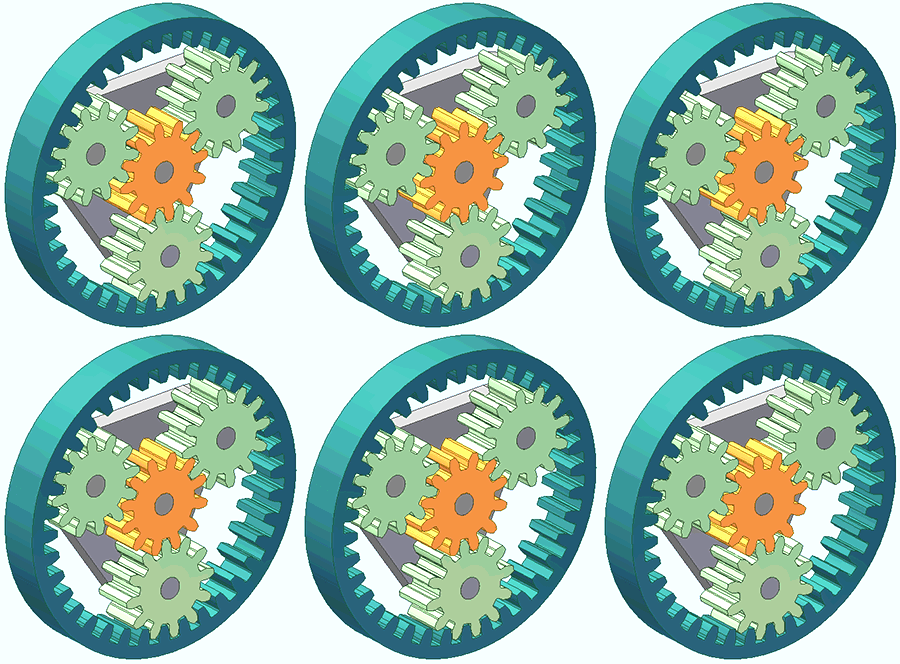
Working principle of DC Planetary Gear Motor
1. When voltage is applied to the DC motor,electrical energy is converted into mechanical rotational energy. The motor’s rotor (armature) spins due to the interaction between the magnetic field and the current in the winding.
2. The motor’s shaft is connected to a sun gear (center gear). This sun gear drives multiple planet gears that rotate inside a larger internal ring gear. These planet gears are mounted on a carrier, which outputs the final rotational motion.
3. Output rotation speed relies on the parameters of a motor and the gear ratio. Multistage models are applied to attain a greater conversion ratio. If corrections of speed are needed, geared motors can be incorporated into speed-controlled systems easily through controlled converters.
Performance Curve of DC Planetary Gear Motor
The performance of a motor and the performance of a gearbox are combined into one graph by displaying three specific parameters, such as speed, torque and efficiency. These performance curves are important when selecting a gear motor for application.
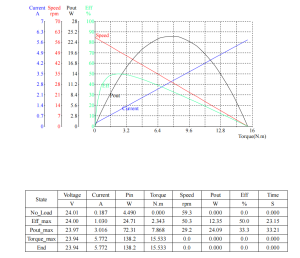
Speed (N): This straight line in the performance curve provides the relationship between torque and speed of a DC gear motor. This line is shifted based on the increment or decrement of voltage.
Current (I): This straight line displays the relationship between current and torque from no-load to full motor stall.
Torque (T): This line on the X-axis is the load represented by the motor shaft.
Efficiency (η): Efficiency is measured using the input and output values shown by the dashed line. It should be used close to its peak efficiency to increase the potential of the DC planetary gear motor.
Output (P): The quantity of mechanical energy output by the gear motor.
The following power curve for a DC gear motor is an example. The maximum operating efficiency (50%) of this DC planetary gear motor is 50 rpm (2.3N.m). When torque is increased, speed and efficiency are decreased. Output power is low for the increased torque, and the unit may not operate if the motor reaches its stall torque (15.5N.m).
Advantages of DC Planetary Gear Motor
1. High Torque in Compact Size
The planetary gear configuration allows for significant torque multiplication without increasing motor size. Ideal for space-limited designs.
2.
High Efficiency
Thanks to multiple gear contact points (sun, planet, ring), power transmission is more efficient and losses are minimized compared to other gear types.
3.
Superior Load Distribution
The load is evenly distributed across multiple planet gears, reducing wear and increasing durability and reliability under heavy loads.
4. Coaxial Design
Input and output shafts are aligned, allowing for sleek, inline designs that are easier to integrate into equipment with limited space.
5.
Precise Speed and Position Control
The gear reduction allows for better control over speed and positioning, essential for robotics, actuators, and automation equipment.
6. Backlash is Minimal
Well-designed planetary systems have low backlash, making them great for applications that require accurate motion like CNC machines or medical devices.
7. Scalability and Customization
Planetary gear motors are modular, allowing for easy customization in terms of speed, torque, and gear ratios.
Greater strength and better efficiency: the main characteristic of a planetary gearbox is to develop more torque in the same space compared to a conventional spur gearbox. This is possible since more gears work simultaneously on the outer ring gear, generating the same torque output in a smaller dimension.
Reduced backlash: the backlash is the measure of position accuracy, resulting from the mechanical play between the teeth of the gears.
Available DC Planetary Gear Motor Models
DongMing manufactures 23 standard DC planetary gear motor models with gearbox diameters from 16 mm to 56 mm. Every model below is a production item with a published datasheet, dimensional drawing and gear ratio table — not a catalogue placeholder. If none of them matches your torque, speed or envelope requirement, we build a custom variant on the same platform.
| Model | Gearbox diameter | Typical voltage |
|---|---|---|
| DM-16PM030 | 16mm | 12/24V |
| DM-16PM050 | 16mm | 3/12V |
| DM-16PMC1620 | 16mm | 3/12V |
| DM-16PMR130 | 16mm | 6/24V |
| DM-22PM180 | 22mm | 6/24V |
| DM-22PM2140 | 22mm | 6/24V |
| DM-22PM2238 | 22mm | 6/24V |
| DM-22PM2247 | 22mm | 12/24V |
| DM-24PM370 | 24mm | 6/24V |
| DM-28PM2965 | 28mm | 12/24V |
| DM-28PM385 | 28mm | 6/24V |
| DM-28PM390 | 28mm | 12/24V |
| DM-28PM395 | 28mm | 6/24V |
| DM-32PM31ZY | 32mm | 12/24V |
| DM-36PM545 | 36mm | 12/24V |
| DM-36PM555 | 36mm | 12/24V |
| DM-36PM597 | 36mm | 12/24V |
| DM-42PM42ZY | 42mm | 12/24V |
| DM-42PM52ZY | 42mm | 12/24V |
| DM-42PM775 | 42mm | 12/24V |
| DM-52PM52ZY | 52mm | 12/24V |
| DM-56PM52ZY | 56mm | 12/24V |
| DM-56PM63ZY | 56mm | 12/24V |
Voltage shown is the typical winding option listed on each product page. Other windings, gear ratios, shaft geometry, encoder and connector options are available on request.
How to Select a DC Planetary Gear Motor in Three Steps
Step 1 — Start from the load, not the motor
Calculate the torque the load actually needs at the output shaft: load force multiplied by the radius it acts on, plus friction and an acceleration margin. Gearbox output torque — not motor torque — decides which diameter class you land in. Choosing a motor first and a gearbox afterwards is the most common cause of oversized, overpriced drives.
Step 2 — Turn the required speed into a gear ratio
Divide the motor’s rated speed by the output speed you need. That gives the reduction ratio i. Because a planetary gearbox adds stages in discrete steps, the achievable ratio is a set of values rather than a continuous range, and each additional stage adds gearbox length while reducing efficiency. Check the ratio table on the model page before fixing the gearbox length.
Step 3 — Check duty cycle, noise and envelope
Continuous duty, intermittent duty and stall-adjacent operation lead to very different thermal margins. If the drive runs in a bedroom, an office or a medical device, noise matters as much as torque. Confirm the gearbox length plus motor length fits the housing before the design is frozen — a planetary gearbox cannot be shortened after tooling.
Applications:
DONGMING MOTOR’s planetary gear motors are most commonly used in robotic and industrial automation applications. Some of our largest customers incorporate our planetary gear motors into drink vending machine, intelligent robot, auto feeding system, Intelligent Medicine Box. The high precision and efficiency of our motors ensure that all types of applications operate at the highest level.
Frequently Asked Questions
What is the difference between a DC planetary gear motor and a spur gear motor?
A planetary gearbox distributes load across several planet gears inside a ring gear, so it delivers more torque in the same envelope and runs with lower backlash. A spur gear motor is simpler and cheaper but takes more axial space for the same ratio. See the full comparison for torque, efficiency and service life.
How many gear stages does a planetary gearbox need?
It depends on the ratio. Low ratios are reachable in one stage, while high ratios require three or more stages. Each stage lengthens the gearbox and lowers efficiency, so the right answer is the lowest stage count that still meets the ratio and the torque requirement.
Can a DC planetary gear motor be customised?
Yes. Winding voltage, gear ratio, output shaft, gearbox flange, encoder, cable and connector can all be adapted on the standard platforms listed above. Send the load, speed, voltage and envelope and we will confirm feasibility and tooling needs.
Which industries use DC planetary gear motors?
Common uses include robot joints and end effectors, medical pumps and actuators, automatic door and vending mechanisms, smart home drives, bank equipment, and automotive comfort functions. The application pages cover each industry separately.
Need a planetary gear motor matched to your load?
Send us the required output torque, output speed, supply voltage and available space. Our engineers will come back with a model recommendation, a ratio option and a quotation — typically within one working day.